
The best powered USB hubs make it easier to connect multiple peripherals without overloading a computer’s built-in ports. They are especially useful for desktop workstations, gaming setups, home offices, and shared charging areas.
This roundup compares 10 powered USB hubs across port count, USB speed, charging support, switching controls, and included power adapters so you can choose the right fit for your setup.
Best 10 Powered USB Hubs Picks for 2026
Best Switch-Controlled Pick
Atolla 8-Port Powered USB 3.0 Hub
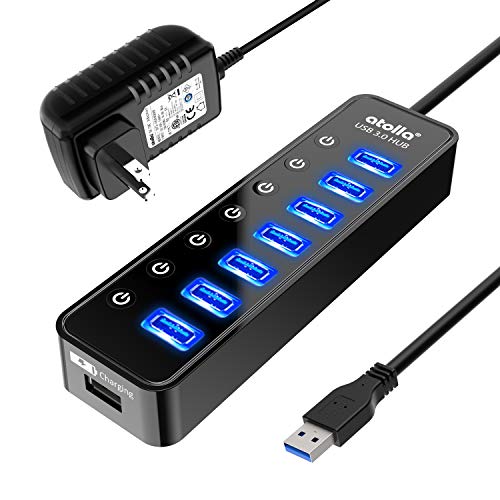
- Seven USB 3.0 data ports with up to 5Gbps transfers
- Individual switches for each port
- Dedicated charging port with included 5V/4A adapter
Best For: Workstations needing flexible port control and charging
Best High-Power Option
SABRENT 10-Port Powered USB 3.0 Hub

- Seven USB 3.0 data ports plus three charging ports
- 60W 12V/5A power adapter included
- Individual switches and LED status indicators
Best For: Busy desktop setups with many peripherals and charging needs
Best for Maximum Port Count
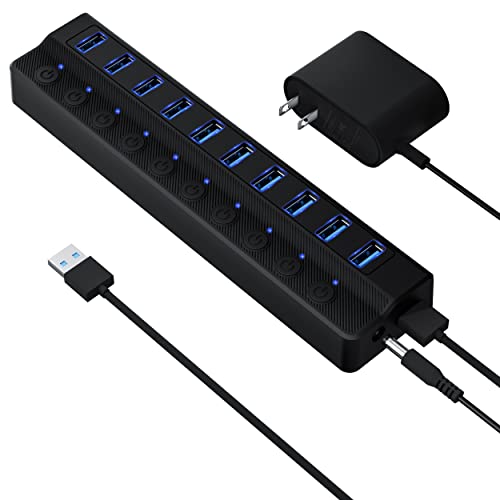
- Ten USB 3.0 ports with up to 5Gbps transfers
- Individual switches and port-status LEDs
- Includes a 12V/2A adapter and USB 3.0 cable
Best For: Large peripheral setups needing many data connections
Best Protected Charging Hub

- Seven USB 3.0 data ports and two smart-charging ports
- Multiple protection features for connected equipment
- Includes a 12V/4A adapter and supports major operating systems
Best For: Home and office users prioritizing charging and protection
Best Compact Control

- Four USB 3.0 ports with up to 5Gbps transfer speeds
- Individual LED-lit power switches
- Compact design with included 2.5A adapter
Best For: Compact desktop or travel setups needing per-port control
Best for Charging Extras
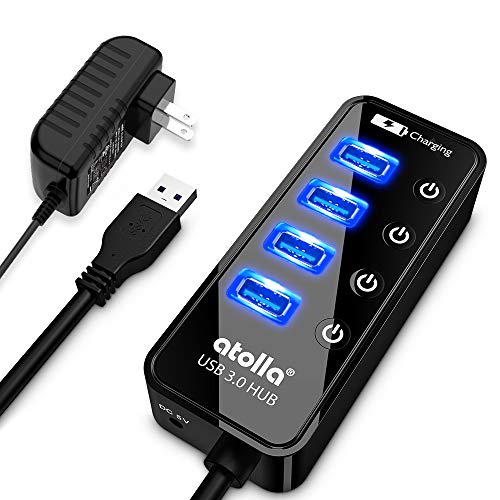
- Four 5Gbps USB 3.0 data ports
- Dedicated charging port up to 2.4A
- Individual switches and 65 cm cable
Best For: Workspaces combining USB peripherals with phone or tablet charging
Best High-Capacity Option

- Nine-port layout with 10Gbps USB 3.2 connections
- Two dedicated 45W USB-C PD charging ports
- Includes 65W adapter and angled aluminum housing
Best For: USB-C workstations needing varied high-speed expansion
Best for Flexible Desk Control

- Four USB 3.0 data ports up to 5Gbps
- Dedicated USB-C charging port
- Individual switches with LED indicators
Best For: Compact workstations needing data ports and USB-C charging
Best for a Durable Workstation Hub

- Aluminum-alloy enclosure
- Four USB 3.0 data ports up to 5Gbps
- Smart charging port and individual switches
Best For: Home and office desks seeking compact, sturdy expansion
Best for Maximum Port Expansion

- Ten USB 3.0 data ports
- Dedicated smart charging port
- Individual switches and LED status lights
Best For: Busy desktop setups with many USB peripherals
Best Switch-Controlled Pick – Atolla 8-Port Powered USB 3.0 Hub
If you need powered USB hubs for a desk with several peripherals, the Atolla expands one USB 3.0 connection into seven USB 3.0 data ports plus a dedicated smart-charging port. Its individual switches make it easy to manage connected equipment without repeatedly unplugging cables.
Best For: Users who want port-level control, fast data transfers, and a dedicated charging connection.
Pros:
- Seven USB 3.0 data ports support transfer speeds up to 5Gbps.
- Individual on/off switches help control each connected device.
- Includes a 5V/4A adapter and a dedicated charging port rated up to 2.4A.
- Plug-and-play compatibility with Windows, macOS, and Linux systems.
Cons:
- Only seven ports are intended for data, despite the eight-port total.
- The enclosure is plastic rather than aluminum.
This is a practical choice for a busy workstation where independent port control matters. The included power adapter and 18-month warranty add useful everyday convenience.
Best High-Power Option – SABRENT 10-Port Powered USB 3.0 Hub
Among powered USB hubs, the SABRENT stands out for its 60W power adapter, 10-port layout, and separate charging ports. It provides seven USB 3.0 device connections for peripherals and drives, while three additional ports are designed for smart charging.
Best For: Desktop users who need multiple USB connections and substantial external power.
Pros:
- Supports up to seven USB 3.0 devices with transfer speeds up to 5Gbps.
- Three dedicated charging ports can deliver up to 2.4A per port.
- Includes a 60W 12V/5A power adapter for stable operation.
- Individual switches and LED indicators simplify port management.
Cons:
- Three ports are dedicated to charging rather than data transfer.
- The listed warranty is one year.
Choose this model when power capacity and port count are higher priorities than a minimal setup. Its aluminum enclosure and per-port controls make it well suited to a loaded desktop station.
Best for Maximum Port Count – ONFINIO 10-Port USB 3.0 Hub
The ONFINIO is one of the powered USB hubs to consider when you need ten extra USB 3.0 connections in one enclosure. It supports up to 5Gbps transfers, individual power switches, and compatibility with USB 3.0 and earlier devices.
Best For: Users who need the largest available data-port expansion for a computer, smart TV, or gaming setup.
Pros:
- Adds ten USB 3.0 ports with transfer speeds up to 5Gbps.
- Individual switches and LED indicators provide convenient power control.
- Includes a 12V/2A power adapter and USB 3.0 cable.
- Works with Windows, macOS, Linux, and ChromeOS, according to the supplied specifications.
Cons:
- It does not list dedicated smart-charging ports.
- The plastic enclosure may feel less premium than an aluminum design.
- The included 12V/2A adapter provides less rated power than some alternatives here.
This hub makes the most sense when maximizing simultaneous data connections is the main goal. Its switches and two-year warranty are helpful additions for a permanently connected setup.
Best Protected Charging Hub – TP-Link UH720 Powered USB Hub
The TP-Link UH720 is a strong option among powered USB hubs for users who want seven USB 3.0 data ports alongside two smart-charging ports. Its protection features are designed to help guard connected equipment during everyday data transfer and charging.
Best For: Homes and offices that need dependable peripheral expansion plus fast smartphone or tablet charging.
Pros:
- Seven USB 3.0 data ports support speeds up to 5Gbps.
- Two dedicated 5V/2.4A smart-charging ports support phones and tablets.
- Includes overheat, overload, overvoltage, short-circuit, and surge protection features.
- Supports Windows, Mac, Chrome, and Linux with plug-and-play setup.
Cons:
- The design is plastic rather than aluminum.
- The listed dimensions are larger than several competing hubs.
The UH720 is a sensible all-around pick if charging convenience and protection features matter as much as data expansion. Its two-year warranty and included 12V/4A adapter further suit regular home or office use.
Best Compact Control – 4-Port USB 3.0 Hub
If you want straightforward powered USB hubs for a desktop, laptop, or travel setup, the SABRENT HB-UMP3 adds four USB 3.0 ports without taking much desk space. Its individually switched ports make it easy to disconnect devices without repeatedly unplugging them.
Best For: Users who want compact USB expansion with individual port controls for peripherals, storage devices, or other compatible USB equipment.
Pros:
- Four USB 3.0 ports support data speeds up to 5Gbps and work with USB 2.0 and USB 1.1 devices.
- Individual LED-lit power switches let you control each connected port separately.
- Includes a 5V/2.5A power adapter and supports plug-and-play, hot-swappable operation.
- Thin, lightweight design is convenient for travel and saves desk space.
Cons:
- Provides only four total USB ports.
- The enclosure is plastic rather than metal.
The SABRENT is a practical pick when individual power control matters more than a large port count. Its compact design and included adapter make it a sensible powered hub for everyday peripherals.
Best for Charging Extras – 4-Port USB 3.0 Hub
Among powered USB hubs, the atolla 4-port model stands out for combining USB 3.0 expansion with a dedicated charging port. It also includes individual switches and a longer 65 cm cable, giving you more flexibility when arranging a laptop or desktop workspace.
Best For: Users who need four switched USB 3.0 data ports plus a separate port for charging phones or tablets.
Pros:
- Four USB 3.0 data ports support transfer speeds up to 5Gbps.
- Dedicated charging port can provide up to 2.4A for devices such as iPads and iPhones.
- Illuminated individual switches reduce the need to unplug devices.
- Includes a 5V/3A adapter, 65 cm cable, plug-and-play setup, and an 18-month warranty.
Cons:
- The charging port is separate from the four USB 3.0 data ports.
- Its plastic case may be less premium than a metal enclosure.
The atolla is a versatile choice for mixed desktop use, especially if convenient device charging is important. Its longer cable and individual switches add practical flexibility without requiring drivers.
Best High-Capacity Option – 9-Port USB 3.2/C Hub
For setups that need many connections, this powered USB hub expands a compatible USB-C computer with nine ports, including 10Gbps USB 3.2 connections, USB-A ports, and dedicated USB-C PD charging ports. Its 65W adapter is designed to support stable operation across connected devices, though the hub is not intended to charge computers or provide video output.
Best For: USB-C laptop and desktop users who need high-speed data ports, multiple USB-A connections, and separate USB-C charging ports.
Pros:
- Offers nine ports, including USB 3.2 connections rated up to 10Gbps and USB 3.0 ports up to 5Gbps.
- Two dedicated USB-C PD ports provide up to 45W charging for compatible devices.
- Includes a 65W power adapter and USB-C-to-USB-C cable.
- Angled aluminum design with a stable base makes ports easier to access on a desk.
Cons:
- PD charging ports do not support data transfer.
- Does not provide video output and is not recommended for charging computers or other high-power devices.
- Notes advise avoiding simultaneous use of multiple SSDs or removable drives.
This is the most capable option here for port variety and high-speed expansion, particularly for USB-C workstations. Its limitations around video, computer charging, and multiple SSDs should be considered before buying.
Best for Flexible Desk Control – Wenter 5-Port USB 3.0 Hub
If you need powered USB hubs for a compact workstation, this Wenter model combines four USB 3.0 data ports with a dedicated USB-C charging port. It supports data transfers up to 5Gbps and includes separate switches for controlling connected devices.
Best For: Users who want fast peripheral connections, USB-C charging, and individual port control in a five-port hub.
Pros:
- Four USB 3.0 data ports support speeds up to 5Gbps.
- Dedicated USB-C charging port can provide up to 2.4 amps.
- Individual switches and status LEDs help manage connected devices.
- Includes a 100cm USB cable, 120cm power cable, and 24-month warranty.
Cons:
- The USB-C port is for charging only and does not transfer data.
- Some high-power external hard drives may require additional power considerations.
This is a practical powered USB hub for mixed peripheral and charging needs, especially when port-by-port control and cable reach matter. Its dedicated charging port is useful, but shoppers should not mistake it for an additional data connection.
Best for a Durable Workstation Hub – atolla 5-Port USB 3.0 Hub
Among powered USB hubs, the atolla 5-port model stands out with an aluminum-alloy enclosure, four USB 3.0 data ports, and a smart charging port. It is designed for plug-and-play use and supports transfer speeds up to 5Gbps.
Best For: Home and office users who want a compact, aluminum-bodied hub with separate port switches and charging support.
Pros:
- Four USB 3.0 ports support data rates up to 5Gbps.
- Smart charging port provides up to 2.4 amps for compatible devices.
- Aluminum-alloy construction offers an understated workstation design.
- Individual switches, LED indicators, and broad Windows, Mac, and Linux compatibility add convenience.
Cons:
- The fifth port is intended for charging rather than data transfer.
- It provides fewer total ports than larger powered hubs.
The atolla is a well-balanced choice if you want powered expansion without moving to a large multi-port unit. Its aluminum housing and individual controls make it particularly suitable for organized desks and shared work areas.
Best for Maximum Port Expansion – Wenter 11-Port USB 3.0 Hub
For users who need powered USB hubs with substantial capacity, this Wenter model provides ten USB 3.0 data ports plus one dedicated smart charging port. It supports transfer speeds up to 5Gbps and uses individual switches to help control a busy collection of peripherals.
Best For: Desktop setups with many keyboards, mice, printers, flash drives, and other USB peripherals connected at once.
Pros:
- Ten USB 3.0 data ports provide extensive peripheral expansion.
- Dedicated charging port can deliver up to 2.4 amps per port.
- Individual switches and LEDs simplify power management.
- Includes a power adapter, 100cm USB cable, longer power cable, and 24-month warranty.
Cons:
- The charging port is not a data-transfer port.
- The larger 11-port design may be more than needed for a simple desk setup.
- The supplied notes list different power-cable lengths, so packaging details may vary.
This is the strongest option here for sheer port count. It makes sense for a crowded desktop or office station, while smaller setups may prefer a five-port hub that takes up less space.
How We Picked the Best Powered USB Hubs
We focused on Powered USB Hubs that include a dedicated AC adapter, since external power helps support several connected devices more consistently than a bus-powered hub. We also compared USB generation and advertised transfer speeds, total port count, charging-specific ports, individual switches, LED indicators, build materials, and compatibility considerations.
Because these hubs serve different types of buyers, we did not rank them by port count alone. A compact four-port model may be more practical for a simple desk, while a 10- or 11-port hub can better suit a workstation with several storage devices, input peripherals, and accessories.
Quick Comparison
- Best for many peripherals: Choose a 9-, 10-, or 11-port hub when you need to connect numerous devices at once.
- Best for compact setups: Four- and five-port hubs provide useful expansion without taking up as much desk space.
- Best for device management: Models with individual on/off switches let you disable accessories without unplugging them.
- Best for faster connections: A USB 3.2 or 10Gbps model is worth considering for compatible external SSDs and other high-speed devices.
- Best for charging: Look for dedicated smart-charging ports and verify the hub’s stated charging output before buying.
Key Buying Factors for Powered USB Hubs
Port Type, Count, and Layout
Count the devices you expect to use simultaneously, then leave at least one spare port for future additions. Check whether the hub uses USB-A, USB-C, or both, and consider cable placement if your desk has limited space.
Data Speed
USB 3.0 hubs are suitable for keyboards, mice, webcams, printers, flash drives, and many everyday accessories. For frequent large-file transfers, a USB 3.2 or 10Gbps hub can provide higher potential throughput, provided the computer, cable, and connected device support the same standard.
Power and Charging
A powered hub’s adapter determines how much power is available across connected devices. Dedicated charging ports can be convenient, but they do not necessarily turn the hub into a high-wattage laptop charger. Check the adapter rating and charging specifications carefully.
Switches, Indicators, and Construction
Individual switches are useful for conserving power and resetting troublesome accessories. LED indicators make port status visible, while aluminum housing may offer a more premium feel and improved durability. These features are conveniences rather than replacements for speed and power specifications.
Who Should Buy Which Powered USB Hubs?
Choose a four-port hub for a small office or laptop desk with a few permanent accessories. A five- or seven-port option is a balanced choice for most home-office and productivity setups. Select a nine-, 10-, or 11-port model when you regularly connect storage, cameras, input devices, printers, and other peripherals together. If fast external storage is central to your workflow, prioritize the 10Gbps model and confirm compatibility throughout your setup.