
Conference rooms need more than a basic HDMI cable. Laptops, tablets, wireless presenters, legacy displays, and long cable runs often require the right converter, switch, splitter, or extender to keep meetings moving.
This roundup compares 10 solutions for different room layouts and presentation workflows, from compact multi-input adapters to network-based video conversion and long-distance HDMI distribution.
Best 10 Hdmi Converters for Conference Rooms Picks for 2026
Best Multi-Format Switcher
Tripp Lite 4-Port Presentation Adapter

- HDMI, DisplayPort, USB-C, and VGA inputs
- 4K at 60Hz with 4:4:4 color
- Up to 100W USB-C host charging
Best For: Mixed-device conference rooms using one 4K display
Best Conference Dock
AV Access 4K Presentation Switch System

- HDMI and USB-C video inputs
- Three USB 3.0 ports for conference devices
- Automatic source switching and under-table mounting
Best For: Small and medium rooms with webcams and speakerphones
Best Wireless Option
ViewSonic WPD-900 ViewShare Kit

- Miracast and AirPlay screen casting
- Up to 98 feet of wireless transmission
- USB-C charging during casting
Best For: BYOD meetings and cable-free presentations
Best for Multiple Displays

- Mirrors one HDMI source to eight displays
- Supports 4K at 30Hz and 1080p
- Up to 100 feet total transmission distance
Best For: Rooms needing identical content on multiple screens
Best All-in-One Adapter

- Accepts USB-C, HDMI, and Mini DisplayPort inputs
- Supports 4K at 60Hz with HDR10 and two-channel audio
- USB-powered, plug-and-play design for one HDMI display
Best For: Mixed-device boardrooms and conference rooms
Best for Multi-Display Distribution

- Sends one HDMI source to four displays
- Reaches up to 165 feet at 4K/30Hz over CAT6/7
- Includes loop-out, PoC, IR pass-through, and EDID management
Best For: Large rooms and commercial multi-screen AV installations
Best for Shared Connectivity

- Includes DisplayPort, Mini DisplayPort, and USB-C adapters
- Security cable and clamp keep adapters together
- Ring or line formats fit tabletop enclosures
Best For: Shared conference tables with frequent presenter handoffs
Best with Extra Features
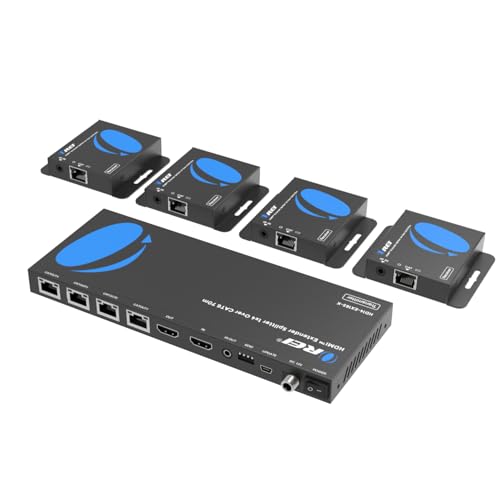
- Sends one source to four displays
- POC powers receivers over Cat6
- Supports local loop-out and IR control
Best For: Wired conference rooms with multiple displays
Best Wireless Convenience

- Supports one transmitter and two receivers
- 4K input with 1080p/60Hz output
- No app, Wi-Fi, or Bluetooth pairing
Best For: Flexible wireless presentations and classrooms
Best for NDI Workflows
Magewell HDMI to NDI Converter

- Converts HDMI video to NDI over Gigabit Ethernet
- Includes HDMI loop-through monitoring
- Supports PTZ, tally, PoE, and USB power
Best For: Professional networked AV and production systems
Best Multi-Format Switcher – Tripp Lite 4-Port Presentation Adapter
Tripp Lite Presentation Adapter 4-Port 4K60Hz HDMI DP USB C & VGA to HDMI (B321-4X1-HDVC)
Check Price On AmazonFor conference rooms that need to support several presenter devices, this Tripp Lite adapter combines HDMI, DisplayPort, USB-C, and VGA connectivity in one 4-port presentation switcher. It supports 4K at 60Hz and includes an 8-foot HDMI cable for a straightforward installation.
Best For: Teams that regularly connect mixed laptop and computer formats to one 4K display.
Pros:
- Accepts HDMI, DisplayPort, USB-C, and VGA sources.
- Supports 4K resolution at 60Hz with 4:4:4 color.
- USB-C PD 3.0 can provide up to 100W for host-device charging.
- Plug-and-play operation requires no software.
Cons:
- Its single-display design is not intended for duplicating one source across multiple screens.
- Includes a 1-year limited warranty.
This is a flexible choice when compatibility is the main concern. The combination of legacy VGA support, modern USB-C and DisplayPort inputs, 4K60 output, and host charging makes it well suited to shared meeting spaces with varied equipment.
Best Conference Dock – AV Access 4K Presentation Switch System
The AV Access conference dock is designed for small and medium meeting rooms where presenters need both video switching and USB conference peripherals. With HDMI and USB-C inputs, automatic source switching, and three USB 3.0 ports, it works as a practical hub for presentations and remote meetings.
Best For: Huddle rooms and meeting rooms that use a room computer, laptop, webcam, and speakerphone.
Pros:
- Supports HDMI 2.0 and USB-C video input up to 4K at 60Hz with 4:4:4.
- Three USB 3.0 ports support conference devices such as webcams and speakerphones.
- Automatically switches when it detects a new HDMI or USB-C source.
- Includes mounting hardware and lockable cables for under-table installation.
Cons:
- It is relatively substantial at 3.55 pounds.
- Its listed video inputs focus on HDMI and USB-C rather than VGA or DisplayPort.
Among HDMI converters for conference rooms, this model stands out as a more complete meeting-room system than a basic adapter. Automatic switching and integrated USB connectivity can reduce cable changes and simplify shared-room setups.
Best Wireless Option – ViewSonic WPD-900 ViewShare Kit
The ViewSonic WPD-900 adds wireless screen casting to a conference room display, allowing participants to share from compatible mobile devices without network setup, software installation, or app downloads. Its peer-to-peer connection and USB-C charging support are useful for BYOD meetings and collaborative presentations.
Best For: Boardrooms, classrooms, and BYOD environments where presenters need cable-free screen sharing.
Pros:
- Supports Miracast and AirPlay across many modern devices.
- Works through a peer-to-peer connection without internet access.
- Supports wireless transmission from up to 98 feet away.
- Allows USB-C charging while casting and supports up to eight transmitters.
Cons:
- It provides one HDMI output rather than multiple display outputs.
- Wireless compatibility depends on the presenting device supporting Miracast or AirPlay.
This is a strong alternative to traditional HDMI converters for conference rooms when reducing cable clutter matters most. It is especially useful for teams presenting from phones, tablets, and laptops, while the peer-to-peer design avoids relying on the room network.
Best for Multiple Displays – MT-ViKI 1×8 HDMI Splitter
The MT-ViKI HDMI splitter sends one source to up to eight displays simultaneously, making it useful when a conference room or presentation space needs the same content visible on multiple screens. It supports 4K at 30Hz and includes a power adapter for longer cable runs.
Best For: Conference rooms, classrooms, churches, and retail spaces that need mirrored content on several displays.
Pros:
- Duplicates one HDMI source across eight HDMI outputs.
- Supports 4K at 30Hz, 1080p, 3D video, and deep color.
- Supports up to 50 feet of input and output cabling per display.
- Plug-and-play setup requires no software or drivers.
Cons:
- It mirrors the source only and cannot extend the desktop.
- It supports 4K at 30Hz rather than 4K at 60Hz.
- All connected displays show identical content.
Choose this splitter when the goal is distribution rather than presenter switching. It is a practical fit for rooms with multiple TVs or projectors that must show the same presentation, signage, or video feed at once.
Best All-in-One Adapter – StarTech 3-in-1 HDMI Adapter
For conference rooms that need to accommodate presenters with different devices, the StarTech 3-in-1 adapter combines USB-C, HDMI, and Mini DisplayPort inputs in one compact unit. It supports up to 4K at 60Hz with two-channel audio, making it a flexible choice among HDMI converters for conference rooms.
Best For: Boardrooms and meeting spaces where guests use a mix of USB-C, HDMI, and Mini DisplayPort laptops or tablets.
Pros:
- Accepts USB-C, HDMI, or Mini DisplayPort host connections.
- Supports UHD 4K at 60Hz, HDR10, and two-channel HDMI audio.
- Requires no external power adapter and includes 11-inch attached host cables.
- Supports HDMI screw-locking cables to help prevent accidental disconnections.
Cons:
- Outputs to a single HDMI display.
- USB-C video requires a compatible USB-C or Thunderbolt 3 device.
- The included power cable uses USB-A, which may require an available USB-A port.
This is a strong fit when connection flexibility matters more than multi-display distribution. Its OS-independent, plug-and-play design can simplify presenter handoffs in shared meeting rooms.
Best for Multi-Display Distribution – 4K HDMI Extender Splitter
When a conference room needs the same presentation on several screens, this 1×4 HDMI extender splitter sends one source to four displays over CAT5/6/7 cabling. It supports 4K at 30Hz over distances up to 165 feet, making it a distribution-focused option among HDMI converters for conference rooms.
Best For: Large conference rooms, training spaces, classrooms, and commercial installations requiring synchronized content on up to four remote displays.
Pros:
- Distributes one HDMI source to four displays simultaneously.
- Supports 4K at 30Hz up to 165 feet over CAT6/7 and 1080p at 60Hz up to 230 feet.
- Includes HDMI loop-out for local monitoring and PoC power over the CAT cable.
- Provides bidirectional IR pass-through and EDID management.
Cons:
- 4K output is limited to 30Hz.
- Requires CAT cabling and receiver installation at each remote display.
- Uses HDMI 1.4, HDCP 1.4, and 8-bit color depth.
This system is better suited to permanent AV deployments than quick laptop connections. Its included transmitter, four receivers, IR accessories, and single-adapter PoC setup can reduce wiring complexity for multi-screen presentations.
Best for Shared Connectivity – LibertyAV HDMI Adapter Ring
The LibertyAV HDMI Adapter Ring keeps DisplayPort, Mini DisplayPort, and USB-C adapters together for quick presenter connections. For shared meeting spaces, its tethered design can make device handoffs easier and help prevent adapters from being misplaced—a practical approach to HDMI converters for conference rooms.
Best For: Conference tables and huddle spaces used by presenters with PCs, laptops, iPads, MacBook Pro models, Galaxy devices, and Chromebooks.
Pros:
- Provides DisplayPort, Mini DisplayPort, and USB-C adapter options.
- Steel security cable and adapter line clamp keep the pieces together.
- Can be arranged in a ring or line configuration.
- Designed to tuck into tabletop enclosures for flexible room layouts.
Cons:
- The supplied notes do not specify supported video resolutions.
- It is an adapter ring rather than a powered signal extender or multi-display splitter.
- It has no power plug and requires a separate HDMI connection to the room display.
This is a convenient infrastructure accessory for rooms where connection readiness and loss prevention are priorities. Choose it when presenters need several common device adapters at the table, rather than long-distance signal distribution.
Best with Extra Features – HDMI Cat6 Splitter Extender
For conference rooms needing one source on several screens, this wired option is one of the more practical HDMI converters for conference rooms. It distributes a single HDMI signal to four remote displays over Cat6, while the transmitter also provides a local HDMI loop-out.
Best For: Meeting rooms, presentations, and installations that need one HDMI source displayed across multiple screens.
Pros:
- Splits one HDMI source to four displays over compatible Cat6/6a/7 cable.
- POC design powers the receivers through the cable, requiring only one power adapter.
- Includes IR pass-back, EDID support, and a local HDMI output.
- Plug-and-play setup with a one-year manufacturer warranty.
Cons:
- Output resolution is limited to 1920×1080 at 60Hz.
- It requires wired Ethernet cabling between the transmitter and receivers.
- Transmission distance and 4K support vary by setup, with 4K listed up to 165 feet.
This is a strong fit when reliability and multi-screen coverage matter more than wireless convenience or higher-than-1080p output. Its included receivers and single-adapter power design can simplify a permanent conference-room installation.
Best Wireless Convenience – Wireless HDMI Conference Kit
When presenters need to connect without running video cable across the room, this wireless kit is a convenient choice among HDMI converters for conference rooms. The transmitter and two receivers mirror video and audio without an app, Wi-Fi connection, or Bluetooth pairing.
Best For: Conference rooms and classrooms where multiple screens need wireless presentation access.
Pros:
- One transmitter can connect with two receivers for multi-screen casting.
- Supports 4K input and 1080p output at 60Hz.
- Claims up to 350 feet in open space and approximately 0.1-second latency.
- Automatic pairing and plug-and-play operation require no app or Wi-Fi network.
Cons:
- Every component requires a power supply.
- Actual range can decrease substantially through solid barriers.
- Output is limited to 1080p at 60Hz despite 4K input compatibility.
This kit prioritizes quick deployment and presenter flexibility over the predictable infrastructure of a wired system. Its two receivers are useful for rooms with more than one display, provided power outlets and a suitable wireless path are available.
Best for NDI Workflows – Magewell HDMI to NDI Converter
For conference rooms integrated into an IP video or livestreaming setup, the Magewell Pro Convert HDMI Plus offers a more specialized approach to HDMI converters for conference rooms. It converts HDMI video to NDI over Gigabit Ethernet while retaining an HDMI loop-through for local monitoring.
Best For: Professional meeting, classroom, and production environments using NDI-enabled software or networked video workflows.
Pros:
- Converts HDMI input up to 4096×2160 into an NDI output stream.
- HDMI loop-through supports real-time local monitoring.
- Works with OBS Studio, vMix, Wirecast, and other NDI-enabled systems.
- Supports PoE or USB power and includes processing, PTZ control, and tally features.
Cons:
- It is more specialized than a basic HDMI-to-display converter.
- NDI operation requires compatible network infrastructure and software.
- Input and output capabilities vary by resolution, frame rate, and color format.
This is the strongest choice of the three for rooms that already use networked production tools. Its loop-through, PTZ support, and web-based control add value for managed AV systems, but may be unnecessary for straightforward screen sharing.
How We Picked the Best Hdmi Converters for Conference Rooms
We evaluated these products by looking at the connection types they support, resolution and refresh-rate capabilities, installation requirements, signal distance, audio handling, and suitability for shared meeting spaces. We also considered whether each device solves a distinct conference-room problem, such as connecting USB-C laptops, switching between presenters, duplicating one source to multiple displays, enabling wireless casting, or transporting video over network cabling.
Because room requirements vary widely, this list includes both simple adapters and more advanced distribution equipment. A compact adapter may be ideal for a huddle room, while a powered splitter, extender, or NDI converter is better suited to a larger installed system.
Quick Comparison
- Best for multiple input types: Tripp Lite Presentation Adapter 4-Port 4K60Hz HDMI DP USB-C & VGA to HDMI.
- Best for presentation switching: AV Access Conference Docking Station.
- Best for wireless casting: ViewSonic WPD-900 ViewShare.
- Best for duplicating one source: MT-ViKI 1×8 HDMI Splitter.
- Best for compact device compatibility: StarTech 3-in-1 adapter or LibertyAV adapter ring.
- Best for long cable runs: The 165-foot CAT5/6/7 HDMI extender or OREI 230-foot extender.
- Best for network video workflows: Magewell Pro Convert HDMI Plus.
Key Buying Factors for Hdmi Converters for Conference Rooms
Inputs, Outputs, and Device Compatibility
Count the source devices and identify their connectors before buying. HDMI is common, but USB-C, DisplayPort, Mini DisplayPort, VGA, and wireless casting may also be necessary. A multi-input adapter or switch can reduce the need for separate dongles at the conference table.
Resolution, Refresh Rate, and Audio
Choose equipment that matches the displays and meeting content. 4K at 60Hz provides smoother motion and is preferable for modern laptops, while 4K at 30Hz may be sufficient for slides and static content. Confirm that the converter supports the required audio format and that it will pass sound through the chosen display or conferencing system.
Distance and Signal Distribution
For one nearby display, a standard adapter may be enough. Larger rooms may need a powered splitter or an extender over CAT5, CAT6, or CAT7 cable. Check the claimed distance under your intended resolution and cabling conditions, and plan for power at the transmitter, receiver, or both ends when required.
Installation and Control
Consider whether the device must be plug-and-play or integrated into a managed AV system. Features such as EDID management, loop-out, IR control, PoC, PoE, and network connectivity can improve reliability but may add setup complexity.
Who Should Buy Which Hdmi Converters for Conference Rooms?
Choose a compact USB-C, HDMI, or Mini DisplayPort adapter for a small room where presenters connect directly to one screen. Select a multi-input conference dock or switch when several guests need to present without repeatedly changing cables. Wireless casting is useful when minimizing table clutter matters more than providing a fully wired workflow.
For rooms showing one source on several displays, use a powered HDMI splitter. Choose an extender when displays are far from the source and dedicated long HDMI cables are impractical. Finally, organizations with centralized AV, streaming, or IP-video infrastructure should consider the Magewell NDI converter, provided their network and staff can support that workflow.