
The right boom arm keeps your microphone stable, accessible, and out of the way when you are recording. For studio desks, the best models balance load capacity, smooth positioning, clamp strength, and quiet operation.
We compared 10 microphone boom arms for studio use across recording, podcasting, streaming, and voiceover setups, with attention to compatibility, workspace clearance, cable management, and everyday adjustability.
Best 10 Microphone Boom Arms for Studio Picks for 2026
Professional Pick
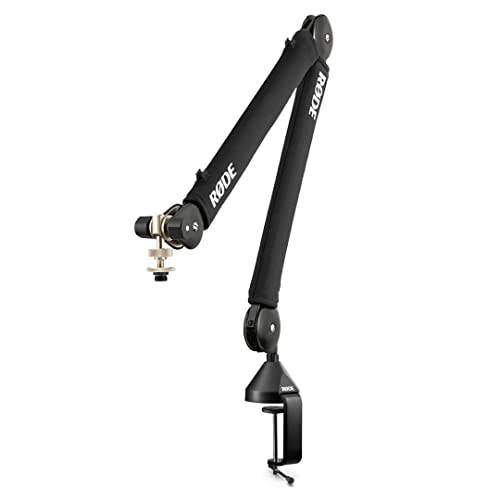
- Quiet internal spring damping
- 360-degree rotation with cable management
- Supports 0.25–1.2 kg microphones
Best For: Podcasters and streamers seeking quiet, tidy positioning
Low-Profile Value
FIFINE BM88 Microphone Boom Arm

- Low-profile design stays below the monitor
- Metal arm with cable management
- 29-inch reach and broad angle adjustment
Best For: Gaming and streaming desks with limited visual clearance
Trusted Versatility
Audio-Technica AT8700 Boom Arm

- Full 360-degree rotation
- 17-inch reach with 16.75-inch height
- Includes USB and XLR cable clips
Best For: Standard desktop recording and streaming setups
Heavy-Duty Low Profile

- Pneumatic damping supports up to 2.5 kg
- 30.2-inch horizontal reach
- Low-profile design with multi-thread adapters
Best For: Heavier microphones and multi-purpose desktop mounting
Heavy-Duty Pick

- 4.4-pound load capacity
- Cable channels and smooth movement
- Supports 1/4-inch, 3/8-inch, and 5/8-inch threads
Best For: Heavy microphones and demanding podcast or streaming setups
Flexible Desk Setup

- 37.4-inch maximum vertical reach
- Includes a 6.3-inch extension riser
- Supports up to 3.5 pounds
Best For: Monitor-spanning podcast and streaming desks
All-in-One Value

- 4-pound steel load capacity
- Includes pop filter and foam cover
- Large clamp fits desks up to 2.4 inches thick
Best For: Beginners wanting a complete home recording package
Best Low-Profile Stability
Aokeo AK-58i Low-Profile Mic Arm

- Low-profile design helps reduce visual clutter
- Supports microphones up to 2 kg
- Includes multiple thread adapters
Best For: Compact gaming, podcasting, and streaming desks
Best Adjustable Value

- Steel arm supports up to 1 kg
- Clamp fits desks up to 5.5 cm thick
- Includes clip, adapter, and cable straps
Best For: Beginner podcasters, streamers, and gamers
Best Heavy-Duty Design
AA AUDIO ACCESSORY ABA01 Mic Arm
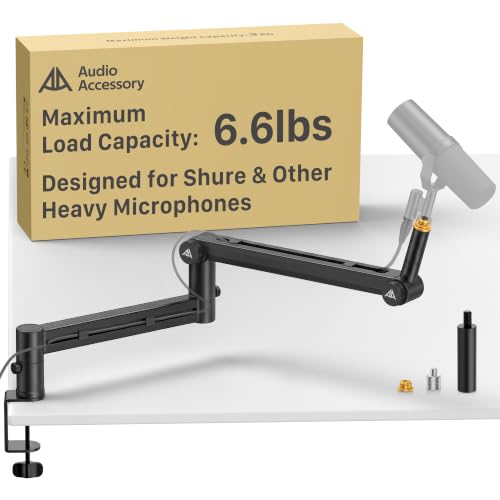
- Handles microphones up to 3 kg
- Gear-lock mechanism helps prevent sagging
- Offers 780 mm reach and cable channels
Best For: Heavy studio microphones such as the Shure SM7B
Professional Pick – RØDE PSA1+ Studio Boom Arm
For creators comparing microphone boom arms for studio use, the RØDE PSA1+ emphasizes quiet repositioning, broad reach, and a clean desk setup. Its internal spring damping and concealed cable routing suit recording environments where handling noise matters.
Best For: Podcasters, streamers, and home-studio users who want a quiet, professional-style arm.
Pros:
- Internal spring damping helps reduce creaks and handling noise during adjustments.
- 360-degree rotation and full extension provide flexible microphone positioning.
- Supports microphones and shock mounts from 0.25 to 1.2 kg.
- Integrated cable management and included 3/8-inch and 5/8-inch adapters keep the setup tidy and compatible.
Cons:
- The clamp fits desks up to 70 mm thick, so it may not suit thicker surfaces.
- Its 1.2 kg maximum load is lower than some heavy-duty arms.
The PSA1+ is a strong all-around choice when quiet movement and a polished broadcast setup matter more than maximum load capacity.
Low-Profile Value – FIFINE BM88 Microphone Boom Arm
The FIFINE BM88 is a practical option among microphone boom arms for studio and gaming desks, especially when keeping the monitor view clear is a priority. Its low-profile design, metal construction, and hidden cable routing are suited to streaming and recording setups.
Best For: Gamers, streamers, and creators who need an unobtrusive arm for a larger desk.
Pros:
- Low-profile design can extend beneath a monitor without obstructing the view.
- Metal construction and a non-slip C-clamp are designed for stable positioning.
- Offers up to 29 inches of extension, 220-degree vertical adjustment, and 360-degree horizontal movement.
- Includes 1/4-inch, 3/8-inch, and 5/8-inch thread compatibility through the supplied adapters.
Cons:
- The microphone is not included.
- The section nearest the C-clamp cannot be adjusted vertically.
- The clamp is intended for desks 0.8 to 2.4 inches thick.
Choose the BM88 when a low-profile silhouette and generous reach are central to your desk layout, particularly for gaming or streaming.
Trusted Versatility – Audio-Technica AT8700 Boom Arm
The Audio-Technica AT8700 keeps things straightforward for buyers seeking microphone boom arms for studio, recording, or streaming setups. It combines a table clamp, full 360-degree rotation, and dedicated cable clips in a compact metal design.
Best For: Users who want a simple, branded boom arm for standard 5/8-inch microphone mounts.
Pros:
- Full 360-degree rotation supports flexible positioning.
- 17-inch boom reach and 16.75-inch vertical height suit many desktop setups.
- Includes six USB cable clips and six XLR cable clips for organized routing.
- Supports up to 1.7 kg and includes a table clamp.
Cons:
- Its 5/8-inch thread is less broadly adaptable than arms with multiple included thread sizes.
- The 17-inch reach may be limiting on especially deep desks.
- Only a two-year limited end-user warranty is specified.
The AT8700 is a sensible, no-fuss pick for users who prefer Audio-Technica construction and need standard rotation and cable organization rather than an unusually long arm.
Heavy-Duty Low Profile – NEEWER MS002 Mic Arm
The NEEWER MS002 stands out among microphone boom arms for studio desks that need low positioning and higher load capacity. Its pneumatic damping, all-metal construction, and adjustable joints are designed for heavier microphones and flexible desktop placement.
Best For: Users mounting heavier microphones, cameras, lights, or monitors on a compact, low-profile desk arm.
Pros:
- Adjustable pneumatic damping supports loads up to 2.5 kg.
- Extends horizontally to 30.2 inches and provides 360-degree pan with additional swivel and tilt movement.
- Low-profile height range of 3.7 to 15.6 inches helps preserve monitor visibility.
- Fits desks from 0.4 to 3.1 inches thick and includes 1/4-inch, 3/8-inch, and 5/8-inch adapters.
Cons:
- Its joints cannot be fully locked, according to the supplied specifications.
- The 3.19 kg arm is comparatively substantial for a desktop accessory.
- Adjusting the pneumatic system requires a hex key and caution around the arm.
The MS002 is the most capable choice here for heavier equipment and extended reach, provided you are comfortable tuning its damping and accommodating its larger, heavier hardware.
Heavy-Duty Pick – FIFINE BM66 Boom Arm
The FIFINE BM66 is a strong choice among microphone boom arms for studio, podcast, and streaming setups that use heavier microphones. Its all-metal build, smooth adjustment, concealed cable channels, and support for several thread sizes make it practical for demanding desktop recording.
Best For: Heavy microphones, professional podcasting, vocal recording, gaming streams, and users who want broad mounting compatibility.
Pros:
- Supports up to 4.4 pounds with a sturdy all-metal construction.
- Reaches about 34 inches and offers 180-degree arm adjustment plus a 360-degree base hinge.
- Built-in cable channels help keep wires protected and organized.
- Includes 1/4-inch, 3/8-inch, and 5/8-inch thread support.
Cons:
- The supplied model is listed without an extension tube.
- Its heavy-duty construction may be more than needed for lightweight microphones.
Choose the BM66 if stability and compatibility matter more than minimizing desk hardware. The 4.4-pound capacity and smooth, knob-free movement suit users who frequently reposition a substantial microphone.
Flexible Desk Setup – InnoGear MU-PSA28 Mic Arm
The InnoGear MU-PSA28 is a flexible option among microphone boom arms for studio desks, especially when you need extra height over a monitor. It combines an extension riser, internal springs, cable channels, and a rotating clamp for adaptable podcasting, streaming, and recording layouts.
Best For: Desk-mounted Blue Yeti, SM7B, and similar microphones, particularly in setups requiring extended vertical reach.
Pros:
- Reaches up to 32.3 inches horizontally and 37.4 inches vertically with the included riser.
- Supports microphones weighing up to 3.5 pounds.
- Offers 135-degree back-and-forth and 180-degree up-and-down adjustment, with a 360-degree base.
- Built-in cable channels and a clamp that fits desks up to 2 inches thick help maintain an organized setup.
Cons:
- The 5/8-inch connector may require the appropriate shock mount for some microphones.
- The shock mount is not included.
The MU-PSA28 stands out when monitor clearance and positioning range are priorities. Its included riser adds useful height, while the 3.5-pound capacity covers many popular podcast and streaming microphones.
All-in-One Value – TONOR T20 Boom Arm
The TONOR T20 is a practical all-in-one choice among microphone boom arms for studio beginners and compact recording stations. Along with its steel arm and upgraded clamp, it includes a mic clip, adapters, pop filter, foam cover, and cable ties for a more complete starting package.
Best For: New podcasters, streamers, and home studio users who want essential microphone accessories included with the arm.
Pros:
- Steel construction supports up to 4 pounds or 1.8 kilograms.
- Provides up to 700mm of horizontal or vertical reach and 360-degree rotation.
- Large clamp contact area fits desks up to 2.4 inches thick.
- Includes a pop filter, foam cover, mic clip, adapter, and cable ties.
Cons:
- Its listed maximum height is 27.55 inches, shorter than some competing options.
- The package includes a mic clip, but not a dedicated shock mount.
The T20 is appealing when accessory value and straightforward setup are more important than maximum reach. Its strong clamp and 4-pound capacity make it a capable starting point for typical home recording applications.
Best Low-Profile Stability – Aokeo AK-58i Low-Profile Mic Arm
For creators comparing microphone boom arms for studio setups, the Aokeo AK-58i emphasizes stability and a discreet footprint. Its low-profile design keeps the arm below the screen area while supporting microphones or shock mounts up to 2 kg.
Best For: Gaming, podcasting, recording, and streaming setups where desk clearance and a low-visibility arm matter.
Pros:
- Low center of gravity helps reduce shaking and shifting.
- 360-degree arm rotation and 180-degree vertical movement provide flexible positioning.
- Supports up to 2 kg and includes 3/8-to-1/4-inch and 3/8-to-5/8-inch adapters.
- Built-in cable routing helps keep wires secured and less visible.
Cons:
- The clamp fits tables less than 7 cm thick.
- The microphone is not included.
The AK-58i is a practical choice when a stable, compact arm is more important than maximum reach. Its low-profile format and broad thread compatibility make it especially suitable for uncluttered desks.
Best Adjustable Value – MAONO BA20 Suspension Mic Arm
The MAONO BA20 is a straightforward option for buyers seeking microphone boom arms for studio work, streaming, or podcasting. Its steel construction, spring design, and adjustable desk clamp provide a conventional suspension-arm setup for microphones up to 1 kg.
Best For: Beginners and creators who need an adjustable arm with a standard clip, cable straps, and broad microphone compatibility.
Pros:
- Angle and height can be adjusted by loosening the knobs for quiet positioning.
- Steel construction and springs support microphones weighing up to 1 kg.
- Upgraded clamp fits desks up to 5.5 cm thick and includes a protective rubber pad.
- Includes a standard microphone clip, thread adapter, and two cable straps.
Cons:
- It may not work with glass tables.
- Its 1 kg capacity limits use with heavier microphones and accessories.
The BA20 offers the essential features most entry-level recording spaces need without an overly complex setup. Check both your desk material and complete microphone weight before buying.
Best Heavy-Duty Design – AA AUDIO ACCESSORY ABA01 Mic Arm
Among microphone boom arms for studio microphones, the AA AUDIO ACCESSORY ABA01 stands out for its 3 kg load rating and gear-lock mechanism. The reinforced low-profile arm is designed for heavier microphones such as the Shure SM7B while providing long reach and concealed cable channels.
Best For: Studio users who need a sturdy arm for heavy microphones and want extra reach without relying on spring-loaded support.
Pros:
- Supports up to 3 kg, or 6.6 lb, for heavier microphone setups.
- Gear-lock design is intended to resist sagging over time.
- 780 mm reach with 360-degree horizontal and 120-degree vertical adjustment.
- Deep cable channels and included 3/8-to-5/8-inch and 3/8-to-1/4-inch adapters improve setup flexibility.
Cons:
- At 1.63 kg, the arm itself is relatively heavy.
- Its heavy-duty construction may be more than needed for lightweight microphones.
The ABA01 is the strongest fit for demanding studio rigs where microphone weight and long-term positioning are priorities. Its gear-lock adjustment and reinforced arms make it a compelling alternative to lighter spring-loaded designs.
How We Picked These Microphone Boom Arms for Studio Use
We focused on the features that matter after installation: stable desk mounting, dependable microphone support, useful reach, smooth adjustment, and practical cable routing. The selection includes professional-style arms, low-profile models for compact desks, heavy-duty options, and budget-friendly suspension arms. We also considered compatibility with common microphones such as the Blue Yeti, HyperX QuadCast, Elgato Wave, and other USB or XLR models.
Because studio desks vary widely, no single arm is ideal for every setup. Clamp design, desk thickness, microphone weight, and available clearance can affect performance as much as the arm itself.
Quick Comparison
| Best For | Look For |
|---|---|
| Professional recording | Quiet movement, strong joints, and reliable spring or pneumatic support |
| Streaming and gaming | Low-profile positioning, easy reach, and clean cable management |
| Heavy microphones | High load capacity, rigid construction, and a secure clamp |
| Small desks | Compact footprint and a low-profile or foldable design |
| Flexible setups | Wide rotation range and standard 3/8-inch or 5/8-inch compatibility |
Key Buying Factors for Microphone Boom Arms for Studio
Load Capacity and Stability
Check the arm’s stated capacity against the microphone, shock mount, pop filter, and any added accessories. Heavy condenser microphones need more than a basic arm can safely support. A rigid clamp and positive locking mechanism help prevent sagging during use.
Adjustment and Reach
Measure the distance from the desk edge to your preferred recording position. A long arm provides more flexibility, while a low-profile model may keep the microphone below your monitor. Look for smooth joints and enough vertical movement to position the capsule correctly.
Desk Clamp and Clearance
Confirm that the clamp fits your desk thickness and can fully contact the underside. Watch for cable trays, drawers, monitor stands, and wall clearance that could limit rotation. A strong clamp is essential for minimizing vibration and accidental movement.
Compatibility and Cable Management
Verify the thread standard and included adapters before buying. Many arms support common 3/8-inch and 5/8-inch mounts, but an adapter may still be necessary. Integrated channels, clips, or a tidy routing path keep cables away from hinges and reduce desk clutter.
Who Should Buy Which Microphone Boom Arms for Studio?
Choose a professional-style arm such as the RØDE PSA1+ if quiet, controlled movement and polished studio handling are priorities. Low-profile options from FIFINE, NEEWER, Aokeo, or AA Audio Accessory suit streamers and creators who need monitor clearance and a compact footprint. Heavy-metal designs such as the FIFINE BM66 are better suited to larger microphones and frequent repositioning.
For a general-purpose podcast or home-recording setup, the Audio-Technica, TONOR, InnoGear, or MAONO options can provide useful adjustability without requiring a premium studio budget. Before ordering, confirm your microphone’s weight, mounting thread, desk dimensions, and the arm’s maximum reach.