
Trying to connect a newer TV to a soundbar that only has an optical input? An HDMI eARC or ARC audio adapter can bridge that gap, but the labels alone do not tell you whether it will work with your TV, audio format, and remote.
These 10 options cover straightforward eARC-to-optical converters as well as extractors with additional connections. Start with the ports on your equipment, then check the formats and features you actually need.
Best 10 Hdmi Earc Audio Adapters for Soundbars Picks for 2026
Best Simple Setup
eSynic eARC/ARC to Optical Extractor

- Single optical output keeps wiring simple
- PCM 2.0, Dolby 5.1, and DTS 5.1
- HDMI, optical, and USB cables included
Best For: Newer TVs paired with optical-only soundbars
Best Basic Converter
AUTOUTLET eARC to Optical Adapter

- One-way TV eARC/ARC to optical
- PCM 2.0, Dolby 5.1, and DTS 5.1
- Requires 5V/1A power; no CEC
Best For: Straightforward optical connections to 5.1-capable audio gear
Best Integrated Cable
PROZOR 7ft eARC/ARC Optical Extractor

- Integrated 7ft HDMI-to-optical setup
- LEDs indicate 2.0 or 5.1 output
- Aluminum housing; USB powered
Best For: Optical soundbars where tidy wiring matters
Best Short-Run Option
ESWN DNXB 3.9ft eARC Optical Adapter

- 3.9ft length suits nearby components
- Specified for 24-bit/192kHz audio
- No Atmos, multichannel PCM, or CEC
Best For: Nearby TVs and optical-input soundbars
Simple Cable Pick
192kHz eARC-to-Optical Converter

- Built-in 41-inch optical cable
- Supports PCM, Dolby 5.1, and DTS 5.1
- No TV-remote volume control over optical
Best For: Nearby optical soundbars needing a compact TV connection
Dual-Optical Pick
eSynic 192kHz eARC Audio Extractor

- Two simultaneous optical outputs
- PCM 2.0, Dolby 5.1, and DTS 5.1 support
- USB-powered; no CEC volume over optical
Best For: One TV feeding an optical soundbar and a second optical device
Flexible Output Pick
HDMI ARC Extractor with Optical and 3.5mm

- Switches between TV ARC and HDMI-source audio
- Optical and 3.5mm audio connections
- No 7.1 support or optical CEC volume
Best For: Setups needing both TV ARC and HDMI-source input options
Most Output Options
4K60Hz HDMI ARC Audio Extractor

- Optical, coaxial, RCA, and 3.5mm outputs
- ARC/eARC-labeled TV port required
- TV-remote volume control on analog outputs only
Best For: TVs feeding soundbars or amplifiers with non-HDMI inputs
Best Cable-Style Option
Tendak eARC/ARC-to-Optical Converter

- Integrated 1.7-meter cable
- PCM 2.0, Dolby Digital 5.1, and DTS 5.1
- No TV-remote volume control or CEC
Best For: Compact TV-to-optical-soundbar setups
Best Status Indicators
eARC/ARC Optical Audio Extractor
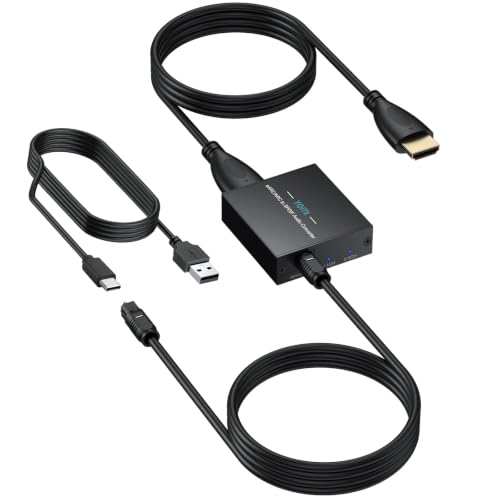
- Supports eARC and ARC TV ports
- 2.0/5.1 channel indicator lights
- Includes HDMI, optical, and USB cables
Best For: Optical setups that benefit from visible audio-status checks
Best Simple Setup – eSynic eARC/ARC to Optical Extractor
Among HDMI eARC audio adapters for soundbars, this eSynic model keeps the connection straightforward: it takes audio from a TV’s labeled eARC/ARC port and sends it to an optical-only soundbar or headphone base.
Best For: Connecting a newer TV to an older optical-input soundbar with the necessary cables included.
Pros:
- Supports PCM 2.0, Dolby 5.1, and DTS 5.1 output.
- Includes HDMI, optical, and USB power cables.
- Compact design with a status LED and just one optical output.
Cons:
- Requires a TV port labeled eARC or ARC; an ordinary HDMI port will not work.
- Optical output does not carry TV-remote CEC volume control.
Choose this if you want an uncomplicated optical connection rather than extra output jacks. Plan to set the TV to eARC/ARC audio output and adjust volume on the soundbar itself.
Best Basic Converter – AUTOUTLET eARC to Optical Adapter
The AUTOUTLET is a one-way TV-to-optical option in the HDMI eARC audio adapters for soundbars category. It converts audio from a TV’s eARC/ARC connection for a soundbar, home theater system, or wireless headphones with optical input.
Best For: Shoppers who need basic eARC/ARC-to-optical conversion with stereo and 5.1-format support.
Pros:
- Supports PCM 2.0, Dolby 5.1, and DTS 5.1.
- Specified for up to 24-bit/192kHz audio.
- Plug-and-play operation requires no drivers or software.
Cons:
- Requires 5V/1A power; the supplied notes specify a cable, not a power adapter.
- No CEC support, and the HDMI-to-optical connection cannot be reversed.
This is a practical pick when your TV has an eARC/ARC port and your audio gear has optical input. Check your available power source before installation, and do not expect TV-remote volume control over optical.
Best Integrated Cable – PROZOR 7ft eARC/ARC Optical Extractor
If cable management matters, the PROZOR stands out among HDMI eARC audio adapters for soundbars: its HDMI cable, converter, and optical cable form an integrated setup with a stated total length of 7 feet.
Best For: Connecting an eARC/ARC-enabled TV to an optical-input soundbar while keeping the adapter wiring compact.
Pros:
- Supports PCM 2.0, Dolby 5.1, and DTS 5.1 formats.
- LED indicators show whether 2.0- or 5.1-channel audio is being output.
- Aluminum-alloy housing and USB power via a TV USB port.
Cons:
- Cannot connect to a soundbar’s ARC port; the soundbar needs optical input.
- One-way conversion does not provide CEC volume control through optical.
The mode LEDs offer a useful check when configuring TV audio. Confirm your TV has a labeled eARC/ARC port, enable that output, and use the soundbar’s controls for volume.
Best Short-Run Option – ESWN DNXB 3.9ft eARC Optical Adapter
This 3.9-foot option is worth considering among HDMI eARC audio adapters for soundbars when the TV and optical-input audio system sit close together. It takes audio from a TV’s labeled eARC/ARC port and outputs it through an optical connection.
Best For: Short TV-to-soundbar connections where a longer cable is unnecessary.
Pros:
- Works with optical-input soundbars, amplifiers, and active speakers.
- Specified for up to 24-bit/192kHz audio.
- No software is needed for setup.
Cons:
- Requires USB power and a genuine TV eARC/ARC port, not standard HDMI.
- No optical CEC volume control; Dolby Atmos and multichannel PCM 5.1/7.1 are not supported.
Check both the cable length and your desired audio format before buying. Set the TV to ARC audio output and a format your sound system can decode, then adjust volume on the audio device.
Simple Cable Pick – 192kHz eARC-to-Optical Converter
Among HDMI eARC audio adapters for soundbars, this cable-style converter is a straightforward way to send audio from a TV’s eARC or ARC port to a soundbar with an optical input. Its built-in optical cable is about 41 inches long, so check the distance between your devices before buying.
Best For: A nearby optical soundbar when you want a compact, plug-and-play TV connection.
Pros:
- Built-in optical cable reduces the number of separate cables needed.
- Supports PCM, Dolby 5.1, and DTS 5.1 when the connected equipment supports the selected format.
- Supports up to 24-bit/192kHz audio sampling.
Cons:
- Requires a TV port labeled eARC or ARC and a USB port or other USB power source.
- Optical output does not provide CEC volume control; adjust volume on the soundbar.
- The fixed 41-inch length may limit placement.
This is the simplest fit of the three if your soundbar is close to the TV. Check your TV’s ARC/eARC settings and audio format, and confirm that the fixed cable will reach.
Dual-Optical Pick – eSynic 192kHz eARC Audio Extractor
For shoppers comparing HDMI eARC audio adapters for soundbars, this eSynic extractor stands out for its two optical outputs. It takes audio from a TV’s labeled eARC or ARC port and sends the same signal to two optical devices, such as a soundbar and another compatible audio device.
Best For: Sending TV audio to an older optical soundbar and a second optical device at the same time.
Pros:
- Two Toslink outputs carry identical audio simultaneously.
- Supports PCM 2.0, Dolby 5.1, and DTS 5.1 formats.
- Includes an optical cable, an eARC/ARC cable, and a USB power cable; status LEDs indicate the incoming channel format.
Cons:
- Must connect to the TV’s eARC/ARC port, not a standard HDMI port or directly to a game console.
- Optical connections do not support TV-remote CEC volume control.
- Requires USB power.
Choose this model when simultaneous optical outputs matter more than remote-controlled volume. If you use ARC, follow the supplied guidance to enable HDMI-CEC on the TV.
Flexible Output Pick – HDMI ARC Extractor with Optical and 3.5mm
This is the most flexible option here among HDMI eARC audio adapters for soundbars: it offers optical and 3.5mm audio connections, plus an ARC output described as supporting TV-remote volume control. A toggle lets you select audio from the TV’s ARC/eARC connection or from an HDMI source device.
Best For: Setups that may need TV ARC/eARC audio or audio extracted from a separate HDMI source, with multiple audio-output options.
Pros:
- ARC-IN and HD-IN switch accommodates two described input scenarios.
- Provides optical and 3.5mm connections for compatible audio equipment.
- Supports PCM 2.0, Dolby 5.1, and DTS 5.1; the stated ARC and 3.5mm outputs support TV-remote volume control.
Cons:
- Does not support 7.1-channel audio.
- Optical output does not support TV-remote volume control.
- Requires selecting the correct switch position for the input you use.
Consider this converter if you need more than a basic TV-to-optical link. Match the output to your soundbar’s available input, and do not expect remote volume adjustment through optical.
Most Output Options – 4K60Hz HDMI ARC Audio Extractor
Among hdmi earc audio adapters for soundbars, this ARC extractor is the flexible pick when your TV’s ARC audio needs to reach equipment with optical, coaxial, RCA, or 3.5mm inputs. Your TV must have an ARC- or eARC-labeled HDMI port.
Best For: Connecting an ARC-capable TV to a soundbar or amplifier with a non-HDMI audio input.
Pros:
- Optical, coaxial, RCA, and 3.5mm audio outputs can operate simultaneously.
- Supports PCM/LPCM setup and lists Dolby Digital 5.1 and DTS 5.1 support.
- Includes an optical cable, USB power cord, and power adapter.
Cons:
- Requires an ARC/eARC-labeled TV port and appropriate TV audio settings.
- TV-remote volume control is limited to the 3.5mm and RCA outputs; optical and coaxial volume must be adjusted at the audio device.
Choose this for output flexibility rather than simple optical-only conversion. Check your soundbar’s available input and set the TV audio output as directed before buying.
Best Cable-Style Option – Tendak eARC/ARC-to-Optical Converter
If you’re comparing hdmi earc audio adapters for soundbars and only need an optical connection, this Tendak converter offers a compact cable-style setup. It takes audio from a TV’s eARC/ARC port to a soundbar or amplifier with an optical input.
Best For: A straightforward TV-to-optical-soundbar connection where a 1.7-meter cable provides enough reach.
Pros:
- Works with TV ports supporting either eARC or ARC.
- Supports PCM 2.0, Dolby Digital 5.1, and DTS 5.1.
- Integrated 1.7-meter cable keeps the setup compact; USB power needs no external power adapter.
Cons:
- Provides optical output only.
- Does not support TV-remote volume control or CEC functions.
- Requires USB power and a TV with eARC or ARC.
This is a tidy choice when optical audio is all you need. Plan to control volume through your soundbar or amplifier rather than the TV’s CEC controls.
Best Status Indicators – eARC/ARC Optical Audio Extractor
For shoppers considering hdmi earc audio adapters for soundbars, this optical extractor adds useful 2.0- and 5.1-channel indicator lights. It converts audio from a TV’s labeled eARC or ARC port for an optical-input soundbar, headphone transmitter, or home theater system.
Best For: Optical audio setups where visible channel-status indicators help during installation.
Pros:
- Supports both eARC and ARC TV connections.
- Supports PCM 2.0, Dolby Digital 5.1, and DTS 5.1 through optical output.
- 2.0/5.1 indicator lights show the detected audio status.
- Includes HDMI, optical, and USB power cables.
Cons:
- Won’t connect to a soundbar that has only an HDMI input.
- Optical output does not support TV-remote CEC volume control.
- ARC TVs may need HDMI-CEC enabled for signal detection.
The indicators make this especially practical for checking what the adapter detects during setup. Confirm that your TV has a labeled eARC/ARC port and your audio device has an optical input.
How We Picked the Best Hdmi Earc Audio Adapters for Soundbars
We focused on the connection problem each adapter is intended to solve: getting audio from a TV’s HDMI eARC or ARC port to a soundbar or other audio device. We compared the stated inputs and outputs, eARC versus ARC labeling, listed audio formats, power requirements, and practical details such as attached cables. Product names are not a substitute for a full specification sheet, so verify the current listing before buying—especially if a feature is essential to your setup.
Quick Comparison: Match the Output to Your Soundbar
Most Hdmi Earc Audio Adapters for Soundbars in this roundup are aimed at sending TV audio to an optical input. That makes them most relevant if your TV has HDMI eARC/ARC but your soundbar lacks a compatible HDMI connection. The HDMI ARC extractors in the selection also mention options such as 3.5 mm audio or video-related specifications; check their port diagrams carefully rather than assuming they work like the simpler eARC-to-optical models.
If your soundbar already has an HDMI eARC or ARC port, first try a direct HDMI connection. An adapter adds another device, cable, and power requirement without necessarily improving the audio.
Key Buying Factors for Hdmi Earc Audio Adapters for Soundbars
Signal Direction and Port Compatibility
Confirm that the adapter accepts audio from your TV’s HDMI eARC/ARC port and outputs through the connection your soundbar accepts. “HDMI to optical” can also describe devices designed for a streaming box or game console, which may not extract audio from a TV’s return channel. Check whether the listing explicitly supports eARC, ARC, or both.
Audio Formats and TV Settings
Optical output is commonly used for stereo PCM and supported compressed surround formats such as Dolby Digital 5.1 or DTS 5.1. Do not assume an optical adapter will carry lossless eARC formats, Dolby Atmos, or every format available through your TV. Match the adapter’s stated support to your soundbar, then set the TV’s digital audio output to a compatible format if you hear silence or get only stereo.
Power, Cables, and Remote Control
Check whether USB power is required, whether a power supply is included, and whether an HDMI cable is attached or must be purchased separately. CEC support matters if you expect the TV remote to control volume or power: some listed adapters explicitly say they do not support CEC. Optical connections also do not inherently provide HDMI-style volume control, so plan for the soundbar’s remote or another supported control method.
Video Specifications
Some extractors advertise 4K resolution or refresh-rate figures. Those specifications matter only if video passes through the device. For a TV eARC/ARC-to-optical connection, prioritize return-audio compatibility over a 4K label.
Who Should Buy Which Hdmi Earc Audio Adapters for Soundbars?
Choose a basic eARC/ARC-to-optical converter if your goal is simply to connect a TV to an optical-only soundbar. Prioritize clearly stated Dolby Digital or DTS support if you want compatible 5.1-channel audio rather than stereo PCM. Consider a model with extra analog outputs only if another speaker system needs them, and check its input and output direction first. If you depend on one-remote volume control or lossless surround audio, a direct eARC connection—or different audio equipment—may be a better fit than an optical adapter.