
The best docking stations with DisplayLink make it easier to connect multiple monitors, peripherals, storage devices, and wired networks to a laptop through a single cable. They are especially useful for systems with limited native display support, including many Apple Silicon MacBook models.
This roundup compares 10 DisplayLink docks across dual- and triple-monitor support, resolution, charging, ports, operating-system compatibility, and practical desk use.
Best 10 Docking Stations with Displaylink Picks for 2026
Compact Value Pick
Giq USB 3.0 Dual-HDMI DisplayLink Dock

- Dual HDMI mirroring or extending
- Three USB 3.0 ports plus Ethernet
- Compact design, but no laptop charging
Best For: Portable basic dual-display workstations
Triple-Display Workstation Pick
WAVLINK 3-Monitor DisplayLink Dock

- Up to 4K + 2K + 2K at 60Hz
- 100W laptop charging
- Six 10Gbps USB ports and Ethernet
Best For: Multi-monitor home offices and workstations
Mac Dual-4K Pick
Plugable 14-in-1 DisplayLink Dock

- Two 4K 60Hz extended displays
- 100W charging and 14-in-1 connectivity
- Works around certain Mac display limits
Best For: Mac productivity and dual-4K office setups
Best Budget Dual-Display Pick

- Dual HDMI output up to 1920x1200 at 60Hz
- Six USB ports plus Ethernet and audio
- No laptop charging or 4K support
Best For: Productivity setups needing dual HD monitors and extensive USB connectivity
Best Premium Dual-Display Hub
Belkin DisplayLink Dual Display Dock

- Two displays up to 4K at 60Hz
- Up to 100W laptop charging
- 10Gbps data and 1Gb Ethernet
Best For: Modern USB-C workstations requiring high-resolution dual displays and charging
Best Triple-Monitor Workstation Dock
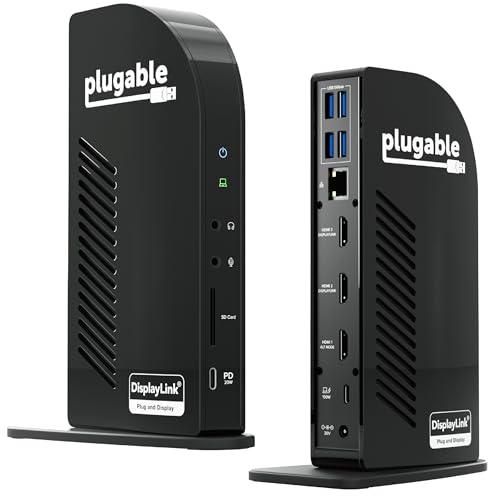
- Supports three extended HDMI displays
- 100W laptop and 20W accessory charging
- Includes Ethernet, SD, USB-A, and audio ports
Best For: Multi-monitor offices and enterprise-style workstation deployments
Best for Triple-Display Expansion
WAVLINK 15-in-1 DisplayLink Dock

- Supports up to three monitors for productivity workflows
- 15 ports include USB-C, USB-A, Ethernet, SD/TF, and audio
- Up to 100W laptop Power Delivery
Best For: Feature-rich triple-monitor office workstations
Best for Hybrid Office Fleets
Plugable USB-C Triple-Display Dock

- Supports up to three HDMI displays
- 100W Power Delivery plus Ethernet and six USB 3.0 ports
- Designed for Windows, macOS, and ChromeOS deployments
Best For: Managed hybrid workspaces and IT deployments
Best for Dual 4K Productivity
WAVLINK DisplayLink Dual-Monitor Dock

- Supports two 4K@60Hz external monitors
- Flexible HDMI and DisplayPort combinations
- Works with USB-A, USB-C, and Thunderbolt laptops
Best For: Home offices and dual-screen productivity setups
Compact Value Pick – Giq USB 3.0 Dual-HDMI DisplayLink Dock
For shoppers seeking docking stations with displaylink support in a compact format, this Giq model combines dual HDMI output with USB 3.0, Gigabit Ethernet, and SD/microSD card access. It can mirror or extend displays up to 4K at 30Hz or Full HD at 1080p, but its USB-C port is for dock power rather than laptop charging.
Best For: Budget-conscious home, travel, and basic dual-display setups using compatible Mac, Windows, Chrome OS, Ubuntu, or Android devices.
Pros:
- Dual HDMI support for mirrored or extended displays.
- Includes three USB 3.0 ports, Gigabit Ethernet, and card readers.
- Small aluminum-and-plastic design weighs about 3.6 ounces.
Cons:
- Does not charge the laptop through its USB-C port.
- Display output is limited to 4K at 30Hz or 1080p.
- SD and microSD cards cannot be used simultaneously.
This is a practical expansion hub when portability and broad connectivity matter more than high-refresh-rate video or laptop power delivery. Confirm your device and port requirements before buying.
Triple-Display Workstation Pick – WAVLINK 3-Monitor DisplayLink Dock
This WAVLINK dock is built for docking stations with displaylink users who need up to three external monitors from a compatible USB-C laptop. It supports one 4K 60Hz display plus two 2K 60Hz displays, while also offering 100W power delivery, six 10Gbps USB ports, and Gigabit Ethernet.
Best For: Home offices, coding, stock dashboards, online learning, and other multi-screen productivity setups using USB-C, USB4, or Thunderbolt laptops.
Pros:
- Supports up to three displays at 4K + 2K + 2K and 60Hz.
- Provides 100W laptop charging with a supplied 130W power adapter.
- Six USB ports support 10Gbps transfers individually.
- Includes Gigabit Ethernet and heat-dissipation features for extended use.
Cons:
- Requires DisplayLink drivers for Mac systems.
- Does not support USB-A laptops or gaming consoles.
- Not recommended for gaming or HDCP-protected 4K streaming.
With its strong display and connectivity specifications, the WAVLINK is a compelling desk-dock choice for demanding office multitasking. Check that the laptop’s USB-C port supports video output before ordering.
Mac Dual-4K Pick – Plugable 14-in-1 DisplayLink Dock
For Mac users comparing docking stations with displaylink technology, this Plugable 14-in-1 dock is designed to add two extended 4K displays at 60Hz through HDMI, DisplayPort, or a combination of both. It also includes 100W charging, USB ports, card readers, Ethernet, and a headset jack for a complete workstation connection.
Best For: MacBook, Windows, and ChromeOS users who need dual 4K monitor support and a broad selection of desk peripherals.
Pros:
- Enables two 4K 60Hz displays on supported M1–M5 and Neo Macs.
- Offers 100W laptop charging and 14-in-1 connectivity.
- Includes HDMI, DisplayPort, USB, SD/microSD, Ethernet, and audio connections.
- Backed by lifetime support from Plugable’s North American team.
Cons:
- DisplayLink software installation is required.
- HDCP is not supported.
- Requires a full-featured USB-C, USB4, or Thunderbolt connection.
This dock is a strong fit for productivity-focused users who want dual 4K output from Macs with native display limitations. Its driver requirement and HDCP restriction make it less suitable for protected streaming use.
Premium Windows Pick – Anker Prime DL7400 Triple-Display Dock
The Anker Prime DL7400 is a premium option among docking stations with displaylink, offering triple 4K display support for Windows 10/11 laptops. Its 14 ports include 140W upstream power, 2.5Gbps Ethernet, fast USB-C connections, dual HDMI, DisplayPort, card readers, audio, and a smart display with active cooling.
Best For: Windows laptop users building a high-bandwidth, triple-monitor workstation with substantial charging and connectivity needs.
Pros:
- Supports three external 4K displays through two HDMI ports and one DisplayPort.
- Offers up to 140W upstream power and multiple 100W USB-C ports.
- Includes 2.5Gbps Ethernet and numerous 5Gbps/10Gbps USB connections.
- Smart display, built-in fan, and ActiveShield 3.0 help monitor and manage operation.
Cons:
- Compatible devices are listed as USB-C Windows laptops.
- Requires the latest DisplayLink driver.
- DRM-protected streaming may show a black screen.
This is the most feature-rich choice here for a Windows workstation that needs three 4K screens and fast wired networking. Use the included USB-C 3.2 Gen 2 cable, and account for the DisplayLink streaming limitations.
Best Budget Dual-Display Pick – Plugable UD-3900
The Plugable UD-3900 is a practical entry point for shoppers comparing docking stations with DisplayLink. Its hybrid USB 3.0/USB-C host cable connects to two HDMI displays, wired Gigabit Ethernet, audio, and six USB ports, making it well suited to everyday productivity setups.
Best For: Home offices and workstations that need dual HD monitors and plenty of USB connectivity without laptop charging.
Pros:
- Supports two HDMI displays up to 1920×1200 at 60Hz.
- Provides two USB 3.0 ports, four USB 2.0 ports, Gigabit Ethernet, and audio jacks.
- Works with Windows, macOS 14 or later, and ChromeOS 100 or later, with driver requirements varying by platform.
- Includes a two-year warranty and lifetime support.
Cons:
- Does not charge the connected laptop.
- Does not support 4K, DisplayPort connections, gaming, or HDCP-protected streaming content.
- Not compatible with Linux or Unix systems.
This is a sensible productivity-focused dock when dual 1080p-class displays and broad peripheral support matter more than 4K output or power delivery.
Best Premium Dual-Display Hub – Belkin DisplayLink Dual Display Dock
The Belkin DisplayLink Dual Display Dock turns a single full-featured USB-C connection into a 14-in-1 workstation. Among docking stations with DisplayLink, it stands out for dual 4K display support, 100W laptop power delivery, 10Gbps data transfer, and compatibility with modern USB-C, USB4, and Thunderbolt systems.
Best For: Users building a polished dual-monitor desk setup around a USB-C laptop, MacBook, Chromebook, or compatible tablet.
Pros:
- Supports up to two HDMI or DisplayPort monitors at up to 4K and 60Hz.
- Delivers up to 100W power delivery to the laptop.
- Offers 10Gbps USB 3.2 Gen 2 data transfer and 1Gb Ethernet.
- Includes VESA mounting, Kensington Lock compatibility, and a three-year coverage period.
Cons:
- DisplayLink installation is required on macOS.
- Requires a full-featured USB-C, USB4, or Thunderbolt connection for the listed compatibility.
- The supplied notes do not specify the complete port layout for all 14 ports.
For a modern office setup, this Belkin dock offers a strong balance of high-resolution displays, charging, fast storage connectivity, and flexible mounting options.
Best Triple-Monitor Workstation Dock – Plugable 13-in-1 USB-C Dock
The Plugable 13-in-1 dock is designed for users who need three extended HDMI screens from one USB-C connection. It is one of the most capable docking stations with DisplayLink in this group, combining triple-display support with 100W laptop charging, 20W accessory charging, Ethernet, storage-card access, and office-focused compliance features.
Best For: Office, education, government, and home-workstation users who need three monitors and a broad selection of connected peripherals.
Pros:
- Supports three extended HDMI displays, including up to 4K at 30Hz on HDMI 1.
- Provides up to 100W laptop charging and 20W charging for phones or accessories.
- Includes three HDMI ports, four USB-A 5Gbps ports, SD card access, Gigabit Ethernet, and audio.
- Compatible with Windows 10+, macOS 11+, and ChromeOS systems with suitable USB-C, USB4, or Thunderbolt ports.
Cons:
- HDMI 2 and HDMI 3 require DisplayLink Manager installation on macOS.
- HDMI 2 and HDMI 3 are limited to 1920×1200 at 60Hz.
- Does not support HDCP-protected content such as Netflix or Hulu.
This dock is the strongest choice here for a multi-monitor command center, especially when charging, card-reader access, and deployment-oriented connectivity are part of the brief.
Best for Triple-Display Expansion – WAVLINK 15-in-1 DisplayLink Dock
If you need docking stations with DisplayLink for a busy office setup, this WAVLINK model offers extensive connectivity and support for up to three monitors. Its DisplayLink-6350 chipset is aimed at productivity tasks such as spreadsheets, dashboards, reports, and data analysis rather than gaming or professional video editing.
Best For: Windows and Mac users building a feature-rich triple-monitor workstation with extensive peripheral and storage connectivity.
Pros:
- Supports up to three monitors, with dual 2K@60Hz available through the primary HDMI/DisplayPort channels.
- Provides 15 ports, including HDMI, DisplayPort, USB-C, USB-A, Ethernet, SD/TF, and audio connections.
- Supplies up to 100W Power Delivery with the included 130W adapter.
- Works with Windows, macOS, Chrome OS, Ubuntu, Android, and HarmonyOS systems when supported drivers are installed.
Cons:
- DisplayLink driver installation is required; it is not plug-and-play.
- HDMI Alt Mode requires a USB-C port with video output support.
- Its design is focused on office productivity, not gaming or professional video editing.
This is a strong choice when port variety and three-screen productivity matter most. Check your laptop’s USB-C video and Power Delivery support, and remember that HDMI and DisplayPort on the same display channel cannot be used simultaneously.
Best for Hybrid Office Fleets – Plugable USB-C Triple-Display Dock
For organizations comparing docking stations with DisplayLink, this Plugable model combines DisplayLink graphics with native USB-C video output. It supports up to three HDMI displays and is designed for managed workspaces, hot-desking, conferencing, and data-focused productivity across Windows, macOS, and ChromeOS.
Best For: Hybrid teams and IT deployments that need triple-display connectivity, wired networking, USB peripherals, and host charging.
Pros:
- Supports up to three extended HDMI displays: one 4K@30Hz Alt Mode display and two 1080p@60Hz DisplayLink displays.
- Offers 100W USB-C Power Delivery for compatible host systems.
- Includes Gigabit Ethernet, six USB 3.0 ports, audio, and broad USB-C, USB4, and Thunderbolt compatibility.
- Includes North American-based technical support and a compatibility guarantee.
Cons:
- DisplayLink driver installation is required on macOS.
- Not compatible with Linux systems.
- HDCP is not supported.
This dock is particularly practical for mixed-device offices where dependable connectivity and support matter as much as display expansion. Its display configuration is useful for productivity, though the two DisplayLink screens are limited to 1080p at 60Hz.
Best for Dual 4K Productivity – WAVLINK DisplayLink Dual-Monitor Dock
This WAVLINK dock is a practical option among docking stations with DisplayLink for users who want two high-resolution monitors from a USB-A, USB-C, or Thunderbolt laptop. It supports dual 4K@60Hz displays and adds USB peripherals, Ethernet, and audio, but it does not charge the laptop.
Best For: Home-office and everyday productivity users who need dual 4K screens and broad laptop-port compatibility.
Pros:
- Supports up to two 4K@60Hz external monitors.
- Offers flexible dual HDMI, HDMI plus DisplayPort, or dual DisplayPort configurations.
- Works with USB-A, USB-C, USB4, and Thunderbolt 3, 4, and 5 laptops.
- Includes six USB 3.0 Type-A ports, Gigabit Ethernet, and a 3.5mm audio jack.
Cons:
- DisplayLink driver installation is required for video output.
- It does not provide laptop charging.
- Not designed for gaming, high-frame-rate video editing, or DRM-protected streaming content.
Choose this model if dual 4K monitor support is more important than charging or newer high-speed USB ports. Its compatibility with both USB-A and USB-C laptops makes it convenient for shared home or office workstations.
How We Picked the Best Docking Stations with Displaylink
We focused on docks that use DisplayLink technology to expand a laptop’s monitor options beyond what its native USB-C or Thunderbolt display support may allow. The selected models cover USB 3.0 and USB-C connections, dual- and triple-display configurations, HDMI and DisplayPort outputs, and a range of charging capacities.
We also considered compatibility, maximum resolution and refresh rate, useful expansion ports, power delivery, setup requirements, and whether a dock is better suited to home offices, professional workstations, or flexible multi-device setups. DisplayLink docks generally require software, so operating-system support and driver availability remain important parts of the buying decision.
Quick Comparison
- For basic dual-monitor expansion: USB 3.0 and Plugable dual-display docks offer practical connectivity for office laptops and older computers.
- For triple-monitor setups: WAVLINK, Anker, and Plugable triple-display models provide more screen space for productivity workflows.
- For higher-resolution displays: Look for models advertising dual 4K support at 60Hz, while checking the exact output combination and host connection.
- For USB-C laptop charging: Prioritize docks with high-wattage Power Delivery, such as 100W or higher, while remembering that the laptop may receive less after dock power requirements.
Key Buying Factors for Docking Stations with Displaylink
Monitor Count, Resolution, and Refresh Rate
Start with the number of screens you actually need. A dual-monitor dock is usually simpler and less expensive, while a triple-monitor model is better for spreadsheets, creative applications, and large research workflows. Confirm whether the advertised resolution applies to all connected displays simultaneously and whether 60Hz is supported at your preferred resolution.
Host Connection and Compatibility
USB-C docks are convenient for newer laptops, but not every USB-C port supports video output or charging. DisplayLink can help with video expansion, yet the dock still needs compatible drivers and an appropriate data connection. Check support for Windows, macOS, and your specific Mac chip generation before buying. Some protected video content and specialized applications may have limitations with DisplayLink.
Ports, Networking, and Power
Count the ports you use daily: USB-A for older accessories, USB-C for newer devices, Ethernet for stable networking, audio for headsets, and card readers for photography or media work. High-wattage Power Delivery is valuable for a one-cable desk, but verify the included power adapter and your laptop’s charging requirements.
Who Should Buy Which Docking Stations with Displaylink?
Choose a basic USB 3.0 dual-monitor dock if you need affordable expansion for an office laptop and do not require high-speed USB-C peripherals. Pick a USB-C dual-display model for a cleaner modern setup with fewer adapters. Triple-monitor docks are the better choice for users who regularly manage multiple applications, dashboards, or documents at once.
For MacBook owners, confirm the model’s DisplayLink software support and monitor arrangement before purchasing. For demanding workstations, prioritize 4K60 support, reliable Ethernet, sufficient USB bandwidth, and strong power delivery over simply choosing the dock with the largest port count.