The right 3D printer can turn digital sketches, character designs, sculptures, props, and functional art into physical pieces. For artists, print quality matters—but so do color options, material flexibility, setup time, and how easily the machine fits into a creative workflow.
We selected 10 standout options across FDM, resin, multicolor, and 3D-pen categories. This guide explains which features matter most and helps match each type of printer to different artistic goals, skill levels, and studio setups.
Best 10 3d Printers for Artists Picks for 2026
Fast FDM Pick

- 600mm/s maximum printing speed
- One-click automatic bed leveling
- 220 × 220 × 220mm build volume
Best For: Artists wanting fast, accessible FDM printing
Hands-On Creativity Tool
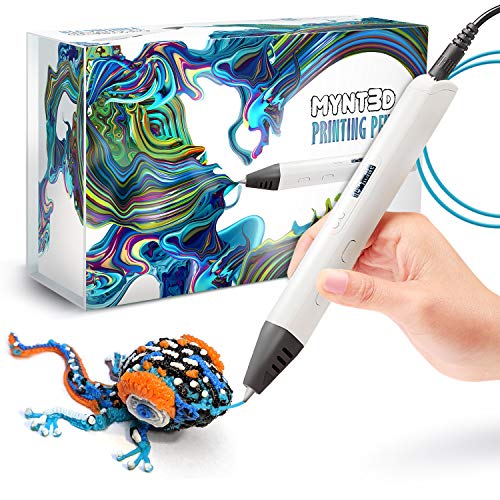
- Adjustable feed speed and flow
- 140°C–230°C temperature range
- OLED temperature display
Best For: Freehand 3D drawing and small creative projects
Fine-Detail Resin Choice

- 7-inch 10K monochrome LCD
- 17 × 17μm pixel size
- 153.4 × 87 × 165mm build volume
Best For: Detailed miniatures and compact resin artwork
Multicolor Studio Pick
FlashForge AD5X Multi-Color 3D Printer

- Prints with up to four colors
- 600mm/s maximum speed
- Automatic IFS filament management
Best For: Colorful FDM artwork and flexible creative prototypes
Best Multicolor Pick

- Native 4-color printing with expansion up to 19 colors
- 260mm cubed build volume and 600mm/s maximum speed
- Automatic leveling, AI monitoring, and broad filament support
Best For: Artists creating colorful, larger models
Best Beginner Value

- Simple assembly with CR Touch auto leveling
- Direct-drive extrusion for PLA, PETG, and TPU
- Quiet operation and easy print removal
Best For: New users making prototypes and everyday creative projects
Best Precision Workflow

- All-metal CoreXY structure with up to 600mm/s speed
- One-click automatic calibration and quick-swap nozzles
- Remote monitoring and print recovery after outages
Best For: Artists needing fast, repeatable, maintainable printing
Best Multicolor Speed Pick

- Four-color printing with no extra assembly
- Up to 500mm/s CoreXY printing
- Auto leveling and print-protection features
Best For: Multicolor cosplay props, models, décor, and prototypes
Best Beginner Mini Printer

- Fully assembled with setup in as fast as 8 minutes
- App includes AI tools and 3,500+ models
- Compact 3.9-inch cubed print volume
Best For: Small creative projects, families, and STEM learning
Fast FDM Pick – FlashForge Adventurer 5M
For artists seeking versatile 3d printers for artists, the FlashForge Adventurer 5M combines high-speed FDM printing with automatic leveling and a flexible PEI build plate. Its 220 × 220 × 220mm build volume suits sculptures, props, prototypes, and other medium-sized designs.
Best For: Artists who want fast, approachable FDM printing with dependable first layers and support for common materials.
Pros:
- 600mm/s maximum speed and 20,000mm/s² acceleration support rapid print production.
- One-click automatic leveling helps simplify setup and first-layer calibration.
- Supports PLA, PETG, TPU, and selected carbon-fiber filaments with compatible nozzles.
- Filament runout detection and power-loss recovery help protect longer projects.
Cons:
- The open design is best used in a well-ventilated environment.
- The standard 0.4mm nozzle supports fewer specialty carbon-fiber options than the 0.6mm setup.
The Adventurer 5M is a practical all-around choice when speed, easy calibration, and material flexibility matter more than resin-level surface detail.
Hands-On Creativity Tool – MYNT3D Professional 3D Pen
The MYNT3D Professional 3D Pen offers a more direct approach to making than a conventional printer. For artists comparing 3d printers for artists, its adjustable feed and temperature controls make it useful for freehand forms, repairs, embellishments, and small creative experiments.
Best For: Artists and makers who want to draw three-dimensional shapes by hand and fine-tune material flow and temperature.
Pros:
- Adjustable feed speed and flow provide control over how material is deposited.
- Temperature adjusts in one-degree increments from 140°C to 230°C.
- OLED display makes the material temperature easy to monitor.
- Includes three PLA filament colors, an AC adapter, and an ergonomic pen body.
Cons:
- It is a handheld 3D pen rather than a programmable, automated 3D printer.
- The included filament selection is limited to three PLA colors.
This pen is best viewed as a compact artistic tool for tactile, freeform work rather than a replacement for a full-size printer.
Fine-Detail Resin Choice – Anycubic Photon Mono 4
The Anycubic Photon Mono 4 is a resin printer focused on fine surface detail. Among 3d printers for artists, its 7-inch 10K monochrome LCD and uniform light source make it a strong fit for miniatures, intricate sculptures, and detailed model work.
Best For: Artists prioritizing high-resolution detail and smooth surfaces in relatively compact resin prints.
Pros:
- 10K resolution with 17 × 17μm pixels supports highly detailed models.
- LightTurbo illumination is designed to reduce layer lines and rasterization.
- The 153.4 × 87 × 165mm build volume accommodates many detailed projects.
- Four-point leveling is intended to remain stable after initial setup, and printing can resume after power restoration.
Cons:
- Its build volume is smaller than the FDM printers in this selection.
- The supplied notes state that Anycubic APP service is not supported.
Choose the Photon Mono 4 when crisp detail is the priority and your projects fit its more compact resin-printing area.
Multicolor Studio Pick – FlashForge AD5X Multi-Color 3D Printer
For colorful creative work, the FlashForge AD5X gives artists four-color FDM printing in a 220 × 220 × 220mm workspace. It stands out among 3d printers for artists by combining automated filament management, high-speed printing, and flexible TPU support.
Best For: Artists and designers creating colorful models, props, prototypes, and flexible printed elements.
Pros:
- Multi-color printing supports designs using up to four colors.
- IFS automatically detects and refills filament to reduce interruptions.
- 600mm/s maximum speed and 20,000mm/s² acceleration support shorter production times.
- All-metal Core XY construction is designed to reduce vibration, and the printer supports flexible TPU.
Cons:
- Multi-color printing adds system complexity compared with a basic single-color FDM setup.
- The 220 × 220 × 220mm build area limits the size of a single print.
The AD5X is the strongest choice here for artists who want color variety and automated filament handling without moving to a smaller resin workflow.
Best Multicolor Pick – Anycubic Kobra X
For artists seeking 3d printers for artists with built-in color flexibility, the Anycubic Kobra X stands out with native four-color printing and expansion potential. Its automatic leveling, fast motion system, and large build volume make it suitable for colorful models and creative prototypes.
Best For: Artists who want multicolor printing, larger creative projects, and broad filament compatibility.
Pros:
- Native four-color printing can expand to as many as 19 colors with compatible ACE 2 Pro units.
- 260 x 260 x 260mm build volume supports sizable models.
- 49-point automatic leveling, AI monitoring, Wi-Fi, and LAN connectivity simplify operation.
- Supports PLA, PETG, TPU, PVA, and ASA with a nozzle temperature up to 300°C.
Cons:
- Filament is not included.
- Expansion requires ACE 2 Pro units, which are separate and incompatible with ACE Pro.
- Its multicolor-focused feature set may be more than needed for simple single-color prints.
The Kobra X is the most creatively flexible option here, especially for artists who want color changes without relying on a single filament. Its automatic setup and remote monitoring also help balance advanced features with everyday usability.
Best Beginner Value – Creality Ender 3 V3 SE
The Creality Ender 3 V3 SE is a practical entry point among 3d printers for artists, combining simple assembly with automatic calibration. Its direct-drive extruder and stable motion system support common creative materials such as PLA, PETG, and TPU.
Best For: Beginners and artists who want a straightforward printer for prototypes, props, and everyday projects.
Pros:
- Assembles in a few simple steps for a beginner-friendly start.
- CR Touch auto leveling and automatic Z-offset calibration help produce reliable first layers.
- Sprite direct-drive extrusion supports PLA, PETG, and TPU.
- Flexible PC spring steel plate makes finished prints easier to remove.
Cons:
- Its 250mm/s maximum speed is lower than the faster models in this roundup.
- The supplied notes do not indicate multicolor printing capability.
- Automatic calibration still does not eliminate the need for suitable print settings and material choices.
The Ender 3 V3 SE keeps the learning curve manageable without giving up useful speed or material flexibility. It is a sensible choice for artists prioritizing accessible setup and dependable day-to-day printing over specialty features.
Best Precision Workflow – FlashForge AD5M
For artists who value speed, maintenance, and repeatable results, the FlashForge AD5M is a strong choice among 3d printers for artists. Its all-metal CoreXY structure, one-click calibration, and quick-swap nozzle system make it well suited to both detailed pieces and efficient production runs.
Best For: Artists and makers who need precise, high-speed printing with convenient nozzle changes and remote management.
Pros:
- All-metal CoreXY construction supports high-speed, stable printing up to 600mm/s.
- Fully automatic one-click leveling simplifies first-layer calibration.
- Quick-release nozzles in multiple diameters can be changed without tools in as little as three seconds.
- Remote monitoring, batch file transmission, and power-loss print recovery improve workflow efficiency.
Cons:
- The 220 x 220 x 220mm build volume is smaller than the Kobra X’s.
- Multicolor printing is not listed among the supplied features.
- Access to different nozzle diameters may require purchasing additional nozzles.
The AD5M offers a polished balance of speed and control for artists who iterate often or manage several print jobs. Its smaller build area may limit oversized work, but automatic calibration and tool-free maintenance make the workflow especially convenient.
Best Multicolor Speed Pick – Creality K2 SE 4C
For artists seeking 3d printers for artists that can handle colorful prototypes, cosplay accessories, and decorative pieces, the Creality K2 SE 4C combines four-color printing with high-speed CoreXY motion. Its compact footprint and automated setup make it practical for studios, classrooms, and home workspaces.
Best For: Artists and makers creating multicolor props, models, personalized gifts, and prototypes.
Pros:
- Supports four-color printing without extra assembly or complicated upgrades.
- Reaches speeds of up to 500mm/s with 20,000mm²/s² acceleration.
- Auto bed leveling and an all-metal frame support consistent first layers and reduced vibration.
- Filament monitoring, tangle detection, power-loss recovery, and partial-failure skipping help protect longer prints.
Cons:
- Its 35.5-pound weight may make repositioning difficult.
- The feature-rich Creality OS, Fluidd UI, and root-access options may be more than beginners need.
The K2 SE 4C is the strongest fit here when color and production speed matter most. It also offers a useful balance of beginner-friendly automation and advanced control for artists whose projects grow more demanding.
Best Versatile Workhorse – ELEGOO Neptune 3 Pro
The ELEGOO Neptune 3 Pro is a practical choice among 3d printers for artists who want a standard-size build area and dependable material handling. Its quick assembly, auto leveling, and direct-drive extruder support everyday creative projects with less setup.
Best For: Artists making medium-sized sculptures, props, models, and functional creative pieces.
Pros:
- The 225 x 225 x 280 mm build volume suits a broad range of daily projects.
- Direct-drive extrusion supports PLA, TPU, PETG, and ABS.
- Thirty-six-point auto leveling helps simplify first-layer setup.
- Dual lead screws, dual Z-axis motors, and POM V-guide wheels support stable movement.
Cons:
- It requires more initial assembly than a fully assembled mini printer.
- It does not offer the multicolor printing system included with the Creality model.
Choose the Neptune 3 Pro if you value a useful build size, broad filament compatibility, and steady mechanical performance over specialized color features. It is a flexible foundation for artists who want room to explore different materials.
Best Beginner Mini Printer – Entina Tina2C
For beginners exploring 3d printers for artists, the Entina Tina2C keeps the learning curve low with full assembly, guided app setup, and a compact design. WiFi control, a model library, and creative modules make it especially approachable for small artistic and educational projects.
Best For: Beginners, families, and artists creating small models, STEM projects, and quick creative experiments.
Pros:
- Fully assembled and designed to begin printing in as fast as eight minutes.
- Poloprint Cloud provides AI-powered search, photo-to-print features, and more than 25 creative modules.
- Supports WiFi and TF card offline printing.
- Auto leveling, a flexible magnetic plate, and power-loss recovery simplify operation.
Cons:
- The 3.9 x 3.9 x 3.9 inch print volume limits projects to small builds.
- Its compact format is less suitable for large props or sculptures.
The Tina2C is the easiest entry point for artists who prioritize convenience and guided creativity. Its small build area is a clear limitation, but the app tools and simple maintenance make it well suited to learning and frequent small prints.
How We Picked the Best 3d Printers for Artists
We evaluated these models by looking at the features that most affect artistic work: detail quality, color and material flexibility, print speed, calibration, ease of use, reliability, and overall project range. We included both conventional FDM printers and a resin model because they suit different creative needs. A 3D pen is also useful for small sculptures, repairs, decorative details, and hands-on modeling.
Automatic leveling, quick setup, direct-drive extrusion, multicolor systems, enclosed designs, and wireless controls can all reduce friction. However, no single printer is ideal for every artist, so the best choice depends on whether you prioritize large functional prints, fine surface detail, vibrant color, or beginner-friendly operation.
Quick Comparison
- Best for fast general-purpose printing: Look at the FlashForge Adventurer 5M or AD5M.
- Best for multicolor projects: Consider the FlashForge AD5X or Creality K2 SE 4C.
- Best for fine miniature detail: The Anycubic Photon Mono 4 resin printer is the strongest fit.
- Best for beginners: The Entina Tina2C, Creality Ender 3 V3 SE, or ELEGOO Neptune 3 Pro offer approachable starting points.
- Best for hands-on sculpting: The MYNT3D Professional Printing 3D Pen provides a more direct, sketch-like workflow.
Key Buying Factors for 3d Printers for Artists
FDM Versus Resin
FDM printers melt filament and are generally versatile, affordable, and easier to use for larger props, models, organizers, and functional artwork. Resin printers cure liquid resin layer by layer and typically produce sharper detail, making them better suited to miniatures, jewelry prototypes, figurines, and intricate sculptures. Resin printing requires ventilation, protective equipment, washing, and curing.
Detail, Size, and Speed
Consider the scale and finish of your work. Fine layer resolution is valuable for facial features, textures, and small forms, while a larger build volume matters for statues, masks, and installation pieces. High-speed printing is convenient, but print quality also depends on calibration, motion stability, cooling, and the material used.
Color and Material Options
Multicolor printers can simplify character models, decorative pieces, and prototypes that would otherwise require painting or assembly. Standard FDM filament also offers broad material choices, while resin provides specialized finishes and very fine detail. Check whether the printer supports the materials you expect to use and whether switching colors creates waste or extra setup.
Ease of Use and Studio Practicalities
Auto-leveling, automatic calibration, removable build plates, Wi-Fi or app control, and quick assembly are especially helpful when you want to spend more time designing than troubleshooting. Also check the printer’s footprint, noise, ventilation needs, maintenance requirements, and availability of replacement nozzles, beds, vats, or other consumables.
Who Should Buy Which 3d Printers for Artists?
Choose a fast FDM printer if you make larger artwork, props, prototypes, or practical studio tools and want a broad material selection. Choose a multicolor model if color separation is central to your designs and you want to reduce hand painting. Choose a resin printer if surface detail and miniature-scale accuracy matter more than convenience or print size. Choose a beginner-focused printer if this is your first machine or you want a simpler classroom, home, or hobby setup. Finally, choose a 3D pen for tactile, freeform work, quick repairs, or adding details to printed pieces.