
The best 3D printers for hobbyists make it easier to turn digital designs into useful parts, creative projects, props, and personalized gifts. The right choice depends on your experience, available space, preferred materials, and willingness to tune hardware.
We selected 10 standout options across beginner, multicolor, high-speed, large-format, and resin categories. This guide highlights the practical differences so you can choose a printer that fits your projects rather than paying for features you may not use.
Best 10 3d Printers for Hobbyists Picks for 2026
Fast Enclosed Choice

- Up to 500 mm/s printing with high acceleration
- Enclosed design and automatic bed leveling
- Optional AMS enables printing in up to 16 colors
Best For: Hobbyists seeking fast, automated, enclosed printing
Multi-Material Powerhouse
Snapmaker U1 4-Toolhead 3D Printer

- Four toolheads with approximately five-second changes
- Supports mixed materials and up to 500 mm/s speeds
- Automatic calibration plus app and AI monitoring features
Best For: Makers needing efficient multi-color and multi-material printing
Beginner-Friendly Multicolor Pick

- Full-auto calibration simplifies setup
- Fast, quiet printing with active flow compensation
- Optional AMS lite adds multi-color capability
Best For: Beginners and families wanting easy, automated FDM printing
Value Starter Bundle

- 250 mm/s maximum printing speed
- Auto leveling and auto Z-offset assistance
- Includes four PLA filament colors
Best For: Budget-minded hobbyists starting with everyday PLA projects
Best All-in-One Upgrade

- Up to 600 mm/s printing
- AMS 2 Pro multi-color support
- Automatic calibration and failure detection
Best For: Fast, automated multi-color FDM projects
Best for Fine Detail

- 7-inch 10K monochrome LCD
- 17 × 17 μm XY pixel size
- Power-resume and tested setup
Best For: Detailed resin miniatures and display models
Best Easy-Speed FDM Printer

- Up to 600 mm/s CoreXY printing
- One-click automatic leveling
- Three-second quick-release nozzle
Best For: Fast, low-maintenance FDM printing
Best Compact Multicolor Pick

- AMS lite included for multicolor printing
- Automatic calibration and flow compensation
- Quiet, pre-assembled setup
Best For: Hobbyists wanting simple multicolor printing in a compact home setup
Best Feature-Rich Large-Format Pick

- 600mm/s printing with 260mm cube build volume
- Automatic leveling and one-click setup
- Multicolor expansion and AI monitoring
Best For: Hobbyists who want fast, larger-format, feature-rich printing
Best Enclosed High-Performance Pick
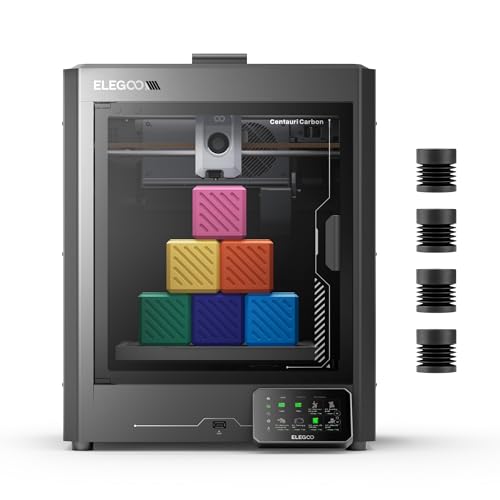
- 500mm/s CoreXY printing with 20,000mm/s² acceleration
- 320°C hardened-steel nozzle and enclosed chamber
- Pre-calibrated with built-in camera
Best For: Hobbyists printing fast, strong, and heat-resistant parts
Fast Enclosed Choice – Bambu Lab P1S
For hobbyists who want speed without assembling a printer from scratch, the Bambu Lab P1S is a ready-to-use enclosed FDM machine with automatic bed leveling and setup in about 15 minutes. It supports common materials such as PLA, PETG, TPU, PVA, PET, ABS, and ASA, while advanced users can also work with PA and PC.
Best For: Hobbyists who prioritize fast printing, simple setup, and an enclosed design for a broad range of everyday and advanced filaments.
Pros:
- Print speeds up to 500 mm/s with 20,000 mm/s² acceleration.
- Enclosed body can improve print performance with advanced filaments.
- Automatic bed leveling and a roughly 15-minute setup reduce initial adjustment.
- Supports optional Bambu Lab AMS multi-color and multi-material printing, up to 16 colors.
Cons:
- The AMS is required for multi-color or multi-material printing.
- Carbon- and glass-fiber-reinforced polymers are not recommended.
- At 38.9 pounds, it is relatively substantial to move.
The P1S is a strong all-around pick among 3d printers for hobbyists when fast output, automation, and enclosure benefits matter more than portability. Add the AMS if multi-color projects are central to your plans.
Multi-Material Powerhouse – Snapmaker U1 4-Toolhead 3D Printer
The Snapmaker U1 stands out for hobbyists who want true multi-color and multi-material printing without repeated manual filament swaps. Its four independent toolheads, automatic calibration, remote control features, and 270 × 270 × 270 mm build volume make it suitable for ambitious models, prototypes, and functional parts.
Best For: Hobbyists, makers, and small workshops that need efficient multi-material printing and a large build area.
Pros:
- Four independent toolheads change in about five seconds and can keep filaments preloaded and preheated.
- Reduces filament waste by up to five times compared with traditional filament-changing systems.
- Supports materials including PLA, PVA, TPU, PETG, PCTG, ABS, ASA, PA, and PC.
- Offers automatic calibration, AI-powered print monitoring, touchscreen control, and remote app control.
Cons:
- Its 59-pound weight and larger footprint may require a dedicated workspace.
- The extensive toolhead and software features may be more than casual users need.
- Maximum speed is dependent on the selected material, model, and print settings.
For hobbyists who regularly combine colors, flexible materials, rigid filaments, or soluble supports, the U1’s tool-changing approach is more capable than a basic single-toolhead printer. Its feature set is especially compelling for demanding projects and repeatable prototyping.
Beginner-Friendly Multicolor Pick – Bambu Lab A1
The Bambu Lab A1 is designed for beginners and hobbyists who want a straightforward entry into fast FDM printing. Full-auto calibration, active flow-rate compensation, a quiet operating design, and a quick-swap nozzle help simplify routine printing and maintenance.
Best For: Beginners, families, and hobbyists who want easy operation, reliable calibration, and an optional path to multi-color printing.
Pros:
- Delivers up to 10,000 mm/s² acceleration for fast printing with precision.
- Automatic Z-offset, bed leveling, and other calibration processes reduce manual setup.
- Active flow-rate compensation helps maintain smooth extrusion.
- AMS lite support enables multi-color printing when purchased separately or in an A1 Combo.
Cons:
- AMS lite is required for multi-color printing and is not included with the standalone printer.
- The supplied notes do not indicate an enclosed design for advanced filament printing.
- Its larger overall dimensions may require more workspace than expected for a beginner printer.
The A1 is an approachable choice among 3d printers for hobbyists, particularly when ease of calibration and quiet operation are priorities. Choose the AMS lite version if colorful prints are part of your intended workflow.
Value Starter Bundle – Creality Ender 3 V3 SE Bundle
Creality Ender 3 V3 SE 3D Printer Bundle with PLA Filament 4 Packs(Black+White+Red+Blue)
Check Price On AmazonThe Creality Ender 3 V3 SE bundle gives hobbyists a practical starting package with the printer and four PLA filament colors: black, white, red, and blue. Its automatic leveling, direct-drive extruder, and 250 mm/s maximum speed make it suited to everyday PLA projects while also supporting TPU and PETG.
Best For: Budget-conscious hobbyists who want a fast starter setup with multiple PLA colors included.
Pros:
- Supports speeds up to 250 mm/s with 2,500 mm/s² acceleration.
- CR Touch auto leveling and a strain sensor automate leveling and Z-offset tasks.
- Full-metal dual-gear Sprite direct extruder supports PLA, TPU, PETG, and smooth filament feeding.
- Bundle includes four PLA filament colors for getting started with multicolor projects.
Cons:
- The included PLA colors do not create automatic multi-color prints by themselves.
- Its open design may be less suitable for materials that benefit from an enclosure.
- The product notes do not specify a full-auto calibration system beyond leveling and Z-offset functions.
As an entry-level option among 3d printers for hobbyists, the Ender 3 V3 SE bundle focuses on useful automation, direct-drive flexibility, and immediate access to several PLA colors. It is a sensible fit for general-purpose projects where advanced enclosure features are not essential.
Best All-in-One Upgrade – Bambu Lab P2S Combo
For hobbyists who want speed, automation, and multi-color capability in one setup, the Bambu Lab P2S Combo is a feature-rich option. It can print at up to 600 mm/s, includes automatic calibration and AI failure detection, and bundles the AMS 2 Pro for multi-color and multi-material printing.
Best For: Hobbyists who want fast, polished FDM printing with automated setup and multi-color projects.
Pros:
- Prints at up to 600 mm/s with active flowrate compensation for smooth, consistent layers.
- AMS 2 Pro supports multi-color and multi-material printing and includes filament drying up to 65 °C.
- Automatic calibration, quick-swap nozzles, and AI failure detection simplify the workflow.
- Adaptive airflow supports both standard and engineering-grade materials, with a carbon filter included.
Cons:
- The P2S printer itself does not support multi-color printing; the Combo version is required.
- At 47.5 pounds, this is a relatively heavy and substantial desktop printer.
The P2S Combo is a strong choice for hobbyists who value convenience and broad creative options over a minimalist setup. Its combination of high speed, automation, and included multi-color hardware makes it especially appealing for frequent, varied projects.
Best for Fine Detail – ANYCUBIC Photon Mono 4
The ANYCUBIC Photon Mono 4 is a resin printer for hobbyists focused on intricate models and smooth surfaces. Its 7-inch 10K monochrome LCD, 17 × 17 μm XY pixel size, and uniform LighTurbo light source are designed to produce highly detailed prints with reduced visible layer lines.
Best For: Hobbyists making detailed miniatures, display models, and other small-to-medium resin projects.
Pros:
- 10K resolution and 17 × 17 μm XY pixel size support exceptionally fine detail.
- LighTurbo matrix lighting provides stable, balanced exposure and can reduce rasterization.
- Print volume measures 153.4 × 87 × 165 mm, offering useful space for daily projects.
- Pre-assembled and tested, with power-resume printing and a one-year warranty plus lifetime technical support.
Cons:
- The resin build volume is smaller than that of many full-size FDM printers.
- It requires a resin-printing workflow rather than the simpler filament-based approach.
- First-use setup still requires leveling before printing.
Choose the Photon Mono 4 when surface detail is more important than large-format versatility. Its high-resolution screen and stable light source make it a compelling entry point for resin-focused hobbyists, especially those who appreciate a tested, largely prepared printer.
Best Easy-Speed FDM Printer – FLASHFORGE AD5M
The FLASHFORGE AD5M is a practical pick for hobbyists who want high-speed FDM printing without spending much time on calibration and maintenance. Its CoreXY all-metal structure supports speeds up to 600 mm/s, while one-click auto leveling and a quick-release nozzle make routine use more approachable.
Best For: Beginners and experienced hobbyists who want fast, low-maintenance FDM printing with a 220 mm cube build area.
Pros:
- CoreXY motion structure enables high-speed printing with stable, low-noise operation.
- Fully automatic one-click leveling helps establish an accurate first layer.
- Tool-free quick-release nozzles can be changed in about three seconds, with multiple diameters available.
- Supports remote monitoring, print management, outage recovery, and a flexible double-sided PEI plate.
Cons:
- The listed print size is limited to 220 × 220 × 220 mm.
- Multi-printer monitoring and batch transmission depend on the Orca-Flashforge slicer ecosystem.
The AD5M balances speed and usability well for everyday FDM projects. Its automatic leveling and quick nozzle changes reduce common maintenance friction, while the CoreXY design and remote-management tools give more advanced hobbyists room to streamline their workflow.
Best Compact Multicolor Pick – Bambu Lab A1 Mini Combo
For hobbyists who want an approachable entry into multicolor 3D printing, the Bambu Lab A1 Mini Combo combines a pre-assembled design, automatic calibration, and the included AMS lite system. Its compact footprint and quiet operation make it practical for home workspaces.
Best For: Hobbyists seeking easy, quiet, multicolor printing in a compact setup.
Pros:
- Includes AMS lite for accessible multicolor printing.
- Automatic bed leveling, Z-offset, and other calibration processes simplify setup.
- Pre-assembled design can be ready for a first print in about 20 minutes.
- Active motor noise cancellation keeps operation at 48 dB or less.
Cons:
- The AMS lite is required for multicolor printing, so the combo is the appropriate configuration for that feature.
- The compact A1 Mini format may be less suitable for especially large models.
The A1 Mini Combo is a strong fit when convenience and multicolor capability matter more than a larger build area. Automatic calibration and flow-rate compensation reduce routine adjustments, while the quick-swap nozzle helps with maintenance.
Best Feature-Rich Large-Format Pick – Anycubic Kobra X
The Anycubic Kobra X is designed for hobbyists who want fast, largely automated printing with more room for larger projects. It combines a 260mm cube build volume, broad material compatibility, multicolor expansion, and camera-based monitoring.
Best For: Hobbyists making larger models who value speed, multicolor options, and automated monitoring.
Pros:
- Print speeds reach up to 600mm/s, with vibration compensation for detailed results.
- LeviQ 3.0 provides 49-point automatic bed leveling for easier first layers.
- Supports four colors standard and can expand up to 19 colors with four ACE 2 Pro units.
- Built-in 720P camera offers monitoring, object detection, and spaghetti detection.
Cons:
- Full 19-color capability requires additional ACE 2 Pro units.
- The wide range of features may be more than beginners need for basic single-color printing.
With its sizable build volume, hardened steel nozzle, and support for PLA, PETG, TPU, PVA, and ASA, the Kobra X offers flexibility for varied hobby projects. Its automatic setup and interruption safeguards further suit long-running prints at home.
Best Enclosed High-Performance Pick – ELEGOO Centauri Carbon
For hobbyists planning to print quickly with stronger or more demanding materials, the ELEGOO Centauri Carbon pairs a CoreXY motion system with an enclosed chamber and a 320°C hardened-steel nozzle. It arrives assembled and pre-calibrated for a straightforward start.
Best For: Hobbyists who need high-speed printing and support for advanced, carbon-fiber-reinforced filaments.
Pros:
- CoreXY mechanics deliver speeds up to 500mm/s and acceleration up to 20,000mm/s².
- Enclosed chamber and 320°C hardened-steel nozzle support advanced materials.
- Automatic bed leveling, pre-calibration, and touchscreen controls make setup easier.
- Built-in camera and dual LED lighting enable monitoring and time-lapse capture.
Cons:
- At 38.5 pounds, it is substantially heavier than the other listed options.
- Its advanced material capabilities may be unnecessary for hobbyists printing primarily basic PLA projects.
The Centauri Carbon stands out for combining speed, rigidity, and higher-temperature material support in a ready-to-print package. Its die-cast frame, vibration compensation, and enclosed design are useful for demanding projects where consistency matters.
How We Picked the Best 3d Printers for Hobbyists
We compared these models by looking at setup difficulty, print consistency, speed, build volume, material compatibility, multicolor options, automation, safety considerations, and overall versatility. We also considered how well each printer fits a specific type of hobbyist, from a first-time maker to an experienced user who wants faster production.
FDM printers are generally the most versatile choice for household parts, prototypes, toys, organizers, and cosplay components. Resin printers can capture finer detail, but they require more involved handling, cleaning, curing, and ventilation.
Quick Comparison
| Best For | Recommended Type | Why It Stands Out |
|---|---|---|
| Beginners and families | Easy-to-use FDM | Automated setup and straightforward operation |
| Multicolor projects | FDM with material system | Convenient color changes and expanded creative options |
| Fast printing | CoreXY FDM | High movement speeds with rigid printer frames |
| Fine miniatures and models | Resin | High surface detail and crisp small features |
| Budget experimentation | Entry-level FDM | Lower initial cost and broad filament availability |
Key Buying Factors for 3d Printers for Hobbyists
Printer Type and Materials
Choose FDM if you want inexpensive, widely available PLA, PETG, or TPU filament and larger functional parts. Choose resin when miniature detail matters more than convenience. Resin workflows involve liquid chemicals, washing, curing, and responsible disposal, so they are not ideal for every home.
Build Volume and Speed
A larger build area lets you print bigger parts or several items at once, while high advertised speed can reduce project time. In practice, quality, model geometry, layer height, and acceleration also affect results. A rigid CoreXY design may be preferable for frequent high-speed printing.
Automation and Reliability
Auto-leveling, automatic calibration, filament detection, a heated bed, and a built-in camera can reduce failed prints and troubleshooting. These features are especially valuable for beginners, children using supervised printers, and hobbyists who want to spend more time designing than adjusting hardware.
Multicolor Printing
Material management systems add convenience but can increase cost, waste filament during color changes, and require additional space. They are worthwhile for signs, figures, decorative models, and projects where color changes are central to the design.
Who Should Buy Which 3d Printers for Hobbyists?
First-time users should prioritize a ready-to-use FDM printer with automatic calibration and a simple software workflow. Families and classrooms should look for enclosed or well-contained designs, dependable safety practices, and easy maintenance. Makers printing functional parts may prefer a larger, faster FDM machine with support for more durable materials.
Choose a multicolor model if visual customization is a major part of your projects. Pick a compact printer when desk space is limited or you mostly make small models. Experienced hobbyists seeking miniature detail should consider resin, provided they can provide proper ventilation and follow handling procedures. Finally, compare ongoing costs—not just the printer price—including filament or resin, replacement nozzles, build surfaces, cleaning supplies, and wasted material.