
Choosing among wireless video receivers gets easier when you know what matters most: range, latency, resolution, and how many displays you need to feed.
Our roundup focuses on practical options for presentations, streaming, classrooms, and home setups, so you can match the right system to your workflow.
Best 10 Wireless Video Receivers Picks for 2026
Portable 4K Mirroring Kit
Wireless HDMI Kit for Meetings and Big Screens

- No-app plug-and-play setup
- 1080P@60Hz wireless mirroring
- Includes HDMI and USB-C adapters
Best For: Quick presentations and casual big-screen sharing
Dual-Screen Conference Extender

- One transmitter to two receivers
- 4K input, 1080P@60Hz output
- Metal housing with plug-and-play setup
Best For: Shared conference and classroom displays
Multi-TV Wireless Splitter

- One transmitter supports four receivers
- Pre-paired plug-and-play design
- Dual-band wireless with adapter support
Best For: Multi-screen expansion for shared viewing
Pro Camera Video Link
SYNCO Wireless HD Video System

- 40ms low-latency monitoring
- Up to 300 m transmission
- Fanless 2W design for silent shooting
Best For: Camera monitoring and live production
Multi-Screen Upgrade
Wireless HDMI for Two Displays and Up to 6 Receivers

- Streams to two displays immediately and can expand to 6 RXs.
- Includes USB-C, Micro HDMI, and Mini HDMI adapters.
- Dual-band wireless with dual antennas for steadier signal handling.
Best For: Multi-display rooms that need scalable wireless HDMI
Long-Range Office Pick
1080p Wireless HDMI with Dual Outputs
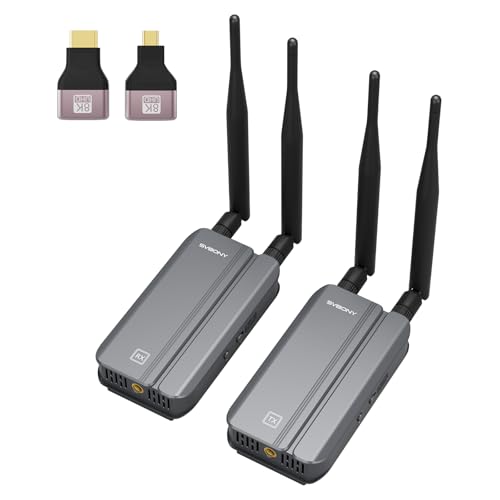
- Factory-paired plug-and-play setup with no software needed.
- Receiver offers two HDMI outputs for synchronized dual displays.
- Supports 1080p@60Hz plus IR control and local loop-out.
Best For: Office monitoring, presentations, and long-range viewing
Distance Champion
820ft Wireless HDMI Extender with Loop Out

- Up to 820ft in open, interference-free conditions.
- 1080p@60Hz with 0.06s latency and IR support.
- Loop out on the transmitter for a local monitor.
Best For: Very long-range HDMI links in open environments
Multi-Screen Wireless HDMI
2 Receiver Kit for Shared Displays

- Mirrors one source to two displays
- Supports expansion up to 8 RX units
- Plug-and-play with LED diagnostics
Best For: Teams and households sharing one HDMI source across multiple screens
Long-Range Wireless HDMI

- Up to 1300 ft in open field use
- 1080p@60Hz with 0.05s latency
- Includes loop out and IR control
Best For: Long-distance HDMI streaming to TVs and projectors
Flexible Power Wireless HDMI

- Dual HDMI out on the receiver side
- Powered by NP-F, Type-C, or portable sources
- Up to 1300 ft with 1080p support
Best For: Camera and monitoring setups needing flexible power and dual displays
Portable 4K Mirroring Kit – Wireless HDMI Kit for Meetings and Big Screens
If you want wireless video receivers that are easy to carry and simple to set up, this wireless HDMI kit is built for quick screen mirroring to a TV, projector, or monitor. It supports up to 1080P@60Hz playback, uses plug-and-play operation with no app or driver, and is designed for presentations, streaming, and everyday sharing.
Best For: Meetings, classroom use, family viewing, and mobile presentations where quick setup matters.
Pros:
- Plug-and-play setup with no driver or app required.
- Supports 1080P@60Hz mirroring for video, audio, and presentations.
- Claims up to 165 ft / 50 m range in open conditions.
- Includes HDMI, USB-C, and mini adapter support for broader device compatibility.
Cons:
- Range can drop sharply through cement walls or between floors.
- Maximum output is 1080P@60Hz, not native 4K output.
- No 5V/2A charger is included.
As a practical wireless video receiver option, this kit makes sense when convenience and portability matter more than advanced pro features. It’s a flexible pick for users who need to mirror content quickly across common HDMI and USB-C devices.
Dual-Screen Conference Extender – Wireless HDMI for 1TX to 2RX
For buyers comparing wireless video receivers for conference rooms or classrooms, this Coolpie kit stands out because it can mirror one transmitter to two receivers. It supports 4K input with 1080P@60Hz output, uses plug-and-play setup, and is built with a metal body for cooler long-session use.
Best For: Multi-screen collaboration, classrooms, conference rooms, and shared viewing setups.
Pros:
- Supports 1TX to 2RX multi-screen mirroring.
- 4K input with 1080P@60Hz output for clear display use.
- Plug-and-play design with no Wi-Fi, Bluetooth, or app required.
- Metal build and ventilation design help with heat dissipation during long use.
Cons:
- The product requires a power supply.
- Wireless performance can still vary with barriers and distance.
- Best value is tied to multi-display use rather than single-screen setups.
This is a strong choice if you need a simple wireless HDMI setup that can feed more than one display. The low-latency claim and auto-pairing design make it especially appealing for business and teaching environments.
Multi-TV Wireless Splitter – Wireless HDMI for 4 Receivers
If you need wireless video receivers for multiple TVs at once, this upgraded HDMI kit is built for multi-screen expansion. One transmitter can work with four receivers out of the box, it supports 1080p@60fps output from 4K decoding, and it is designed for fast plug-and-play use without Wi-Fi or Bluetooth.
Best For: Multi-TV setups in homes, bars, restaurants, or presentation spaces.
Pros:
- Supports one transmitter with four receivers, and up to six receivers total.
- Pre-paired for instant setup with no driver installation.
- Dual-band 2.4G/5G design with dual antennas for stable transmission.
- Includes HDMI, USB-C, mini HDMI, and Micro HDMI adapter support.
Cons:
- Range may reduce to about 50 ft / 15 m when using all four receivers.
- Performance can vary with walls and obstacles.
- 1080p output means it is not a native 4K display solution.
This model is a good fit when your main goal is to send the same source to several screens with minimal setup. It is especially useful for environments where easy expansion matters more than long-range single-display performance.
Pro Camera Video Link – SYNCO Wireless HD Video System
For creators shopping wireless video receivers for camera monitoring, the SYNCO XVision system is aimed at professional shooting workflows rather than casual TV mirroring. It offers 40ms latency, up to 300 m transmission, fanless low-power operation, and a receiver that supports multiple real-time monitoring endpoints.
Best For: Camera crews, interviews, weddings, live events, and on-set monitoring.
Pros:
- 40ms ultra-low latency for near real-time monitoring.
- Up to 300 m reliable transmission in strong conditions.
- Fanless 2W design helps keep shooting silent.
- Receiver supports 1-9 real-time monitoring endpoints.
Cons:
- NP-F battery is not included.
- Designed around HD port camera workflows, not generic consumer HDMI use.
- Best suited to monitoring rather than general home entertainment.
This is the most production-focused option in the group, with the features to support serious on-set use. If your priority is dependable wireless monitoring with low delay and flexible power options, it is a compelling fit.
Multi-Screen Upgrade – Wireless HDMI for Two Displays and Up to 6 Receivers
If you need wireless video receivers for a multi-screen setup, this kit is built to send HDMI content to two displays out of the box and expand to as many as 6 receivers in open environments. It’s aimed at practical installs where you want plug-and-play setup, broad device support, and the option to scale to more TVs without running extra cables.
Best For: Bars, classrooms, conference rooms, churches, and home theaters that need one source on multiple displays.
Pros:
- Supports 1 transmitter to 2 receivers right away, with expansion up to 6 RXs.
- Includes HDMI, USB-C, Micro HDMI, and Mini HDMI adapters for wider compatibility.
- Uses dual-band 5.8GHz/2.4GHz wireless transmission with dual antennas for more stable signal handling.
- Plug-and-play design keeps setup simple for mixed-use spaces.
Cons:
- Transmission distance can drop significantly through walls.
- It cannot do TV-to-TV transmission.
- Apple TV Box output needs to be set to 1080P 60Hz.
Overall, this is a flexible option if your priority is distributing one HDMI source to several displays with minimal setup work. The included adapter set and expansion-friendly design make it especially useful for environments that may grow over time.
Long-Range Office Pick – 1080p Wireless HDMI with Dual Outputs
If you’re comparing wireless video receivers for office monitoring or presentation use, this SVBONY kit focuses on straightforward setup, dual-output flexibility, and long-distance transmission. It supports 1080p video, auto-switches among 9 channels, and includes IR support for controlling the source from the display side.
Best For: Offices, presentations, monitoring setups, and home users who want a plug-and-play long-range HDMI link.
Pros:
- Factory-paired and plug-and-play with no software installation required.
- Receiver has two HDMI output ports for synchronized dual-monitor display.
- Transmitter includes a local HDMI output for operation and demonstration.
- Supports 1080p@60Hz with 9-channel auto-tuning for stable connection selection.
Cons:
- Not recommended for gaming use according to the product notes.
- Requires power via NP-F batteries or Type-C external power.
- Range claims are for open areas with minimal interference.
This is a strong fit if you want a wireless video receiver system centered on convenience, dual-screen output, and long-distance use. Its practical feature set makes it better suited to business and viewing applications than latency-sensitive gaming.
Distance Champion – 820ft Wireless HDMI Extender with Loop Out
For buyers who care most about range, this wireless video receivers kit is built around a long-distance point-to-point HDMI link with support for up to 820ft in open conditions. It keeps the setup simple with plug-and-play operation, while also adding loop out and IR support for more flexible source monitoring and control.
Best For: Conference rooms, churches, classrooms, and home setups that need very long-range wireless HDMI transmission.
Pros:
- Claims up to 820ft transmission in open, interference-free conditions.
- Supports 1080p@60Hz with 0.06s latency for smooth video.
- Includes loop out on the transmitter for a local display.
- IR cables let you control the source from the receiver side.
Cons:
- Walls, bricks, and glass can significantly reduce signal coverage.
- Range decreases as more receivers are added.
- Requires HDMI output devices, so it is not a universal screen-sharing solution.
This model stands out when maximum distance is the top priority and the installation environment is open. If your use case depends on reliable long-range distribution more than multi-room convenience, it’s a compelling option.
Multi-Screen Wireless HDMI – 2 Receiver Kit for Shared Displays
If you need wireless video receivers for a small multi-display setup, this kit is built to mirror one source to two screens with synchronized output. It supports up to 8 RX units with additional receivers, includes LED status feedback, and is designed for plug-and-play use without Wi-Fi, Bluetooth, or app setup.
Best For: Meetings, classrooms, and home setups that need the same HDMI source on two or more displays.
Pros:
- Supports 2 receivers out of the box, with expansion up to 8 RX units
- 1080p@60fps output with built-in 4K decoding for stable playback
- Plug-and-play operation with no drivers, Wi-Fi, or Bluetooth required
- Includes adapters for USB-C, Micro HDMI, and Mini HDMI sources
Cons:
- Range drops to about 50 feet when 8 receivers are connected
- Not for TV-to-TV transmission
- Not compatible with satellite receivers such as Dish Wally
For buyers focused on simple multi-screen sharing, this wireless HDMI option stands out for easy setup and synchronized playback. The practical tradeoff is that the more receivers you add, the shorter the usable range becomes.
Long-Range Wireless HDMI – 1300FT Extender with Loop Out
For buyers comparing wireless video receivers for long-distance signal extension, this kit is aimed at straightforward point-to-point HDMI streaming. It supports up to 1080p@60Hz, includes loop out for a local monitor, and adds IR remote support so you can control the source from the receiver side.
Best For: Long-range HDMI runs to a TV or projector in offices, churches, event spaces, or home entertainment setups.
Pros:
- Up to 1300 ft range in open field conditions
- 1080p@60Hz support with stated 0.05s latency
- Loop out on the transmitter side for local monitoring
- IR remote control support for convenient source access
Cons:
- Walls, metal, bricks, or glass can reduce signal coverage
- As RX units increase, transmission distance decreases
- Limited to HDMI-output source devices and HDMI-input displays
This is a strong fit when distance matters more than advanced networking features. The design is practical and flexible, but the best results still depend on a relatively clear signal path.
Flexible Power Wireless HDMI – 1300FT Dual Output System
This wireless video transmission system is built for users who want long-range HDMI plus more power options than a basic kit. It supports 1080p@60Hz, includes loop out, adds dual HDMI out on the receiver side, and can be powered by NP-F series batteries, Type-C adapters, or portable rechargeables.
Best For: Camera rigs, projectors, and monitoring setups where flexible powering and dual-screen output are useful.
Pros:
- Up to 1300 ft range in open field conditions
- Receiver-side dual HDMI out for two-screen monitoring
- Multiple power options, including NP-F batteries and 5V2A Type-C power
- Plug-and-play setup with IR remote support
Cons:
- Range drops with walls, metal, bricks, or glass in the path
- As RX units increase, transmission distance decreases
- Batteries are not included
Among wireless video receivers in this group, this model is the most adaptable for powered field use and dual-screen monitoring. It keeps the same long-range, 1080p approach while adding more ways to run it in mixed environments.
How We Picked the Best Wireless Video Receivers
We prioritized Wireless Video Receivers that balance real-world usability with performance. That means strong wireless range claims, stable signal transmission, low-latency output, straightforward setup, and support for common HDMI sources. We also looked at whether a model is better suited to single-screen use, multi-room distribution, or larger presentation environments.
Quick Comparison
Some Wireless Video Receivers are built for simple plug-and-play home or office use, while others are designed for longer distances, multiple receivers, or more demanding AV workflows. If you need portability and fast setup, choose a compact kit. If you need to cover a larger space or send video to several displays, look for systems with extender support and higher receiver counts.
Key Buying Factors for Wireless Video Receivers
Range and Environment
Manufacturer range numbers are useful, but walls, interference, and room layout can reduce performance. For small rooms, short-range systems are often enough. For auditoriums, classrooms, or larger homes, long-range kits usually make more sense.
Latency and Video Quality
If you plan to use the system for gaming, live demos, or camera monitoring, low latency is essential. For general presentations or streaming, 1080p may be plenty, while 4K support is more appealing if image detail matters.
Receiver Count and Expansion
Some kits include one receiver, while others support multiple receivers for different screens. If you want to mirror one source across several displays, check the maximum RX count before buying.
Connectivity and Features
Look for HDMI loop-out, IR pass-through, and clear status displays if those features fit your setup. These details can make installation easier and improve day-to-day convenience.
Who Should Buy Which Wireless Video Receivers?
Home users should focus on easy setup, solid signal stability, and quiet operation. Teachers, presenters, and conference teams should prioritize portability, reliability, and multi-receiver support. Content creators, DSLR users, and AV installers should lean toward lower latency, longer range, and feature-rich kits that can handle more demanding workflows.
If you are comparing Wireless Video Receivers for the first time, start with your room size, source device, and display count. Those three factors will usually point you to the best fit faster than specs alone.