
Video editors need fast, flexible storage access when moving footage between bare drives, project archives, and backup media. The right docking station can make that workflow far simpler than installing drives in an enclosure.
These 10 picks cover SATA and NVMe compatibility, USB-C speeds, multi-bay expansion, offline cloning, and convenient features for editing workstations.
Best 10 Hard Drive Docking Stations for Video Editing Picks for 2026
Versatile Cloning Workhorse
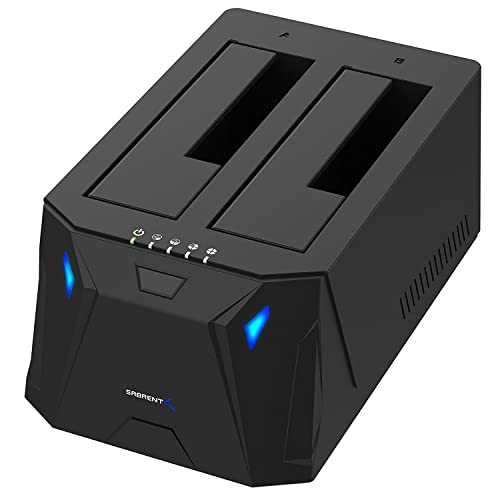
- Supports 2.5-inch and 3.5-inch SATA drives
- Offline cloning with two bays
- USB 3.0 transfer speeds up to 5Gbps
Best For: Editors managing SATA project drives and backups
Fast Format Flexibility

- Reads NVMe and 2.5/3.5-inch SATA drives
- USB 3.2 Gen 2 supports up to 10Gbps
- Includes USB-C and USB-A cables
Best For: Editors using mixed NVMe and SATA media
High-Capacity Archive Hub

- Holds up to five 2.5/3.5-inch SATA drives
- Supports up to 100TB total capacity
- Can duplicate one drive to four targets offline
Best For: Large footage libraries and multi-drive archives
Professional Bare-Drive Access

- Reads two 2.5/3.5-inch SATA drives at once
- USB-C connectivity with up to 522MB/s stated speed
- Independent power switches for each drive
Best For: Desktop editing setups with frequently swapped SATA drives
Best Dual-Bay Cloner

- Simultaneous access to two 2.5-inch or 3.5-inch SATA drives
- Offline one-to-one cloning without a computer
- Tool-free, hot-swappable design with USB-C connectivity
Best For: Two-drive SATA editing workflows and standalone cloning
Best Multi-Format Hub

- Holds two NVMe M.2 and two SATA drives simultaneously
- USB-C 10Gbps connection for large media transfers
- Individual power switches and tool-free drive access
Best For: Mixed NVMe/SATA media libraries and four-drive workflows
Best Aluminum SATA Dock

- Supports two SATA HDDs or SSDs up to 22TB each
- Includes detachable USB-A/USB-C cable and offline cloning
- Aluminum housing with semi-open drive cooling
Best For: Large SATA editing and archive workflows
High-Capacity Hub

- Supports 2.5-inch and 3.5-inch SATA drives
- Offline cloning with LED progress indicators
- Three USB 3.0 hub ports and 48TB total capacity
Best For: High-capacity editing workstations needing extra USB connectivity
Protected Dual-Bay Pick

- Fixed bezels help stabilize inserted drives
- Supports offline cloning and UASP
- Works with 2.5-inch and 3.5-inch SATA drives
Best For: Frequent SATA drive transfers and backup workflows
Simple Cloning Solution

- Connects two 2.5-inch or 3.5-inch SATA drives
- Offers computer-free offline cloning
- Plug-and-play USB 3.0 access for major operating systems
Best For: Straightforward dual-drive backups and media transfers
Versatile Cloning Workhorse – Dual-Bay SATA Dock
For editors working with standard 2.5-inch or 3.5-inch SATA drives, the SABRENT EC-HD2B is a straightforward option among hard drive docking stations for video editing. Its dual bays support drive-to-drive offline cloning, while USB 3.0 connectivity provides up to 5Gbps for accessing project files and backups.
Best For: Video editors who use multiple SATA HDDs or SSDs and want an affordable dock with offline cloning.
Pros:
- Supports both 2.5-inch and 3.5-inch SATA HDDs and SSDs.
- Dual-bay design supports offline cloning without a computer.
- Supports drives up to 10TB and includes USB 3.0 connectivity.
- Plug-and-play setup requires no drivers.
Cons:
- Limited to SATA drives; it does not support M.2 NVMe media.
- USB 3.0 is slower than newer 10Gbps USB-C docks.
This dock is a practical fit for a SATA-based editing workflow, especially when cloning or swapping conventional project drives matters more than maximum interface speed.
Fast Format Flexibility – NVMe and SATA USB-C Dock
The SABRENT DS-UFNC is one of the more flexible hard drive docking stations for video editing because it accepts M.2 PCIe NVMe SSDs as well as 2.5-inch and 3.5-inch SATA drives. USB 3.2 Gen 2 supports up to 10Gbps, and the included USB-C and USB-A cables simplify connection to newer and older computers.
Best For: Editors who move between NVMe SSDs and SATA media and want fast, tool-free drive access.
Pros:
- Supports M.2 NVMe plus 2.5-inch and 3.5-inch SATA drives.
- USB 3.2 Gen 2 provides up to 10Gbps connectivity.
- Includes both USB-C-to-C and USB-A-to-C cables.
- Offers offline cloning and works with Windows, macOS, and Linux.
Cons:
- Actual performance depends on the installed drive.
- Offline cloning requires a target drive equal to or larger than the source.
With broad drive compatibility and a faster USB interface, this is a strong choice for editors who regularly ingest, transfer, or repurpose different types of storage.
High-Capacity Archive Hub – Five-Bay SATA Dock
The ORICO USB-C five-bay dock is designed for editors, photographers, and other users handling large collections of footage. It accommodates up to five 2.5-inch or 3.5-inch SATA drives, with stated support for up to 100TB total capacity, and can duplicate four copies from one source without a computer.
Best For: Professional users who need several SATA drives available for footage storage, archiving, or duplication.
Pros:
- Five-bay design supports large multi-drive workflows.
- Supports up to five drives rated at 20TB each.
- 1:4 offline duplication operates without a computer.
- Aluminum construction and a vertical layout help with heat dissipation.
Cons:
- Designed for SATA drives and does not support NVMe media.
- Its USB 3.2 Gen 1 interface is slower than 10Gbps docks.
- Cloning overwrites target disks, so backups are required beforehand.
This is a capacity-focused choice rather than a compact travel dock. Its five bays and multi-copy duplicator make it especially useful for organized editing archives and repeated backup tasks.
Professional Bare-Drive Access – OWC Dual-Bay Dock
The OWC Drive Dock provides a sturdy way to access two bare 2.5-inch or 3.5-inch SATA drives at the same time. For hard drive docking stations for video editing, its USB-C connectivity, independent power switches, and stated speeds up to 522MB/s suit editors who frequently swap project, source, or backup drives.
Best For: Mac and PC editors who need simultaneous access to two removable SATA drives.
Pros:
- Accesses two 2.5-inch or 3.5-inch SATA drives simultaneously.
- Includes USB-C-to-C and USB-C-to-A cables.
- Independent power switches allow separate drive control.
- Aluminum enclosure and internal power supply support a desktop workflow.
Cons:
- Supports SATA drives only, not M.2 NVMe SSDs.
- It is a relatively heavy desktop unit at 3.1 pounds.
- The supplied details do not list offline cloning functionality.
The OWC is best viewed as a dependable dual-drive access tool rather than a high-capacity duplicator. It makes sense for editors who prioritize convenient drive swapping and simultaneous SATA access.
Best Dual-Bay Cloner – SABRENT USB-C SATA Dock
The SABRENT EC-CH2B is a practical choice among hard drive docking stations for video editing when your workflow uses standard 2.5-inch or 3.5-inch SATA drives. It mounts two drives simultaneously over USB-C and also supports offline one-to-one cloning without a computer.
Best For: Editors and creators managing two bare SATA HDDs or SSDs, moving files between drives, or making standalone drive copies.
Pros:
- Reads and writes two SATA drives at once, with each bay appearing separately on a computer.
- Offline cloning works without a computer and starts with the press of a button.
- Tool-free, hot-swappable bays support both 2.5-inch and 3.5-inch SATA drives.
- Includes a USB-C cable and offers plug-and-play use on Windows and Mac.
Cons:
- Supports SATA drives only; it does not support IDE/PATA, M.2, or NVMe drives.
- The included cable connects by USB-C at the dock end, so a USB-C computer port or separate cable may be needed.
- Offline cloning runs at up to 60MBps, while actual computer transfer speeds depend on the installed drives.
Choose this dock if offline cloning and straightforward two-drive SATA access matter more than NVMe support or a multi-bay setup.
Best Multi-Format Hub – ICY BOX 4-Bay NVMe/SATA Dock
The ICY BOX 4-Bay dock stands out among hard drive docking stations for video editing by combining two NVMe M.2 slots with two SATA bays. Its USB-C 10Gbps connection and independent drive switches make it suited to large media libraries, backups, and flexible multi-drive workflows.
Best For: Video editors who need simultaneous access to up to four mixed NVMe and SATA drives from one USB-C connection.
Pros:
- Supports up to two NVMe M.2 drives and two SATA drives, with each appearing individually.
- USB-C 10Gbps connectivity is designed for fast file transfers and large media workflows.
- Individual power switches let you manage each drive without shutting down the entire dock.
- Tool-free, plug-and-play operation works with Windows, Mac, and Linux.
Cons:
- It has no offline cloning function and is intended for data transfer only.
- Actual performance depends on the installed drives and host connection.
- Its four-drive capacity may be more than needed for a simple two-drive setup.
For mixed-drive editing environments, this is the most versatile option in the group; select it when NVMe access, four bays, and individual power control outweigh the need for offline cloning.
Best Aluminum SATA Dock – RSHTECH Dual-Bay USB-C Dock
The RSHTECH RSH-DS01C is a solid two-bay option among hard drive docking stations for video editing, supporting standard 2.5-inch and 3.5-inch SATA HDDs and SSDs. Its USB-A/USB-C cable, aluminum housing, offline cloning mode, and 22TB-per-drive support suit desktop editing and archive tasks.
Best For: Editors using large SATA drives who want dual-host connectivity, offline cloning, and a durable dock with improved drive ventilation.
Pros:
- Supports two 2.5-inch or 3.5-inch SATA drives, up to 22TB each.
- Includes a detachable 2-in-1 USB-A/USB-C cable for varied host connections, including Thunderbolt ports.
- Offline cloning duplicates a drive without connecting the dock to a computer.
- Aluminum housing, dust caps, semi-open cooling, and a 36W power adapter support a stable setup.
Cons:
- It supports SATA drives but not NVMe or M.2 media.
- Advertised transfer performance depends on host support for UASP and the installed drives.
- It enters automatic sleep mode after 10 minutes of inactivity, which may interrupt an idle workflow.
This dock is a strong fit for SATA-focused editing and archival work, particularly if you value offline cloning, broad USB host compatibility, and a metal enclosure.
High-Capacity Hub – MAIWO Dual-Bay SATA Cloner
For video editors managing large project libraries, the MAIWO is one of the more versatile hard drive docking stations for video editing. Its dual SATA bays support both 2.5-inch and 3.5-inch drives, while three USB 3.0 ports add convenient connectivity for peripherals and removable storage.
Best For: Editors and media professionals who need high-capacity drive access, offline cloning, and extra USB ports in one desktop dock.
Pros:
- Supports 2.5-inch and 3.5-inch SATA HDDs and SSDs, with up to 24TB per bay.
- Offline cloning works without a computer and includes progress indicators.
- Three USB 3.0 hub ports expand connectivity, including one with 2.4A charging.
- Includes a 12V/3A power adapter for stable operation.
Cons:
- Limited to SATA drives rather than newer NVMe storage.
- USB 3.0 transfer bandwidth is rated up to 5Gbps.
The MAIWO stands out when capacity and connectivity matter more than a compact footprint. Its cloning feature is useful for backups, while the hub ports can reduce cable clutter around an editing workstation.
Protected Dual-Bay Pick – WAVLINK SATA Docking Station
The WAVLINK dual-bay model is a practical choice among hard drive docking stations for video editing when you want straightforward access to multiple SATA drives. Its fixed bezels help stabilize and protect inserted drives, while UASP support is designed to improve USB 3.0 transfer performance.
Best For: Editors who regularly move files between two SATA HDDs or SSDs and want a supported offline-cloning workflow.
Pros:
- Accepts 2.5-inch and 3.5-inch SATA I/II/III drives, up to 20TB per bay.
- UASP support enables transfer rates up to 5Gbps over USB 3.0.
- Offline cloning starts from the dock without requiring a computer.
- Includes fixed bezels, a USB-C adapter, and a 12V/3A power adapter.
Cons:
- Only supports SATA drives, not NVMe models.
- The target drive must be equal to or larger than the source for cloning.
With its drive-protecting bezel design and broad operating-system compatibility, the WAVLINK is well suited to routine ingest, backup, and file-transfer tasks. It is a focused storage dock rather than a USB expansion hub.
Simple Cloning Solution – FIDECO Dual-Bay HDD Dock
FIDECO offers a straightforward option for editors who need to connect two SATA drives without installing an enclosure. As one of the simpler hard drive docking stations for video editing, it provides USB 3.0 transfers, plug-and-play access, and offline cloning from a dedicated dual-bay design.
Best For: Budget-conscious editors who need convenient access to two 2.5-inch or 3.5-inch SATA HDDs or SSDs.
Pros:
- Supports two 2.5-inch or 3.5-inch SATA drives simultaneously.
- Offline cloning starts with a five-second press of the Clone button.
- USB 3.0 provides transfer rates up to 5Gbps without requiring drivers.
- Compatible with Windows, macOS, and Linux systems.
Cons:
- Supports SATA drives only.
- New drives must be initialized before a computer can recognize them.
- No extra USB hub ports are listed.
The FIDECO is a practical, uncomplicated dock for adding removable SATA storage to an editing setup. Its offline clone function is especially useful for duplicating project or backup drives without tying up the computer.
How We Picked the Best Hard Drive Docking Stations for Video Editing
We focused on docks that make common editing tasks easier: importing footage, transferring project files, accessing replacement drives, and creating backups. Selection criteria included drive compatibility, interface speed, bay layout, cloning support, construction, capacity claims, and overall workstation practicality.
Because a dock’s real-world performance depends on the drive and computer connection, advertised USB speeds are treated as maximum interface rates rather than guaranteed transfer speeds. We also separated versatile NVMe models from SATA-focused docks so you can match the product to your existing media.
Quick Comparison
| Dock type | Best suited to | What to look for |
|---|---|---|
| Dual-bay SATA | Editors using 2.5- or 3.5-inch HDDs and SSDs | USB 3.x speed, independent bays, stable power |
| NVMe/SATA combo | Modern SSD-based workflows | USB-C 10Gbps support and compatible M.2 formats |
| Four- or five-bay dock | Large media libraries and frequent drive access | Cooling, power delivery, drive separation, desktop footprint |
| Cloning dock | Drive duplication and migration | Offline cloning support and source-to-target capacity matching |
Key Buying Factors for Hard Drive Docking Stations for Video Editing
Drive Compatibility
Confirm whether the dock accepts 2.5-inch SATA SSDs, 3.5-inch SATA hard drives, M.2 NVMe drives, or a combination. SATA and NVMe are different interfaces, so an M.2 slot is not automatically compatible with every M.2 SSD. Check supported lengths and protocols before buying.
Connection Speed
USB 3.0 is adequate for many hard drives, while USB 3.2 Gen 2 or USB-C 10Gbps is more useful for fast SATA SSDs and NVMe storage. The host computer, cable, and drive must all support the higher rate. For demanding 4K workflows, faster connectivity can reduce transfer bottlenecks, but it does not replace a dedicated RAID or Thunderbolt setup.
Bay Layout and Power
Dual-bay models are convenient for copying between drives or keeping two media sources connected. Four- and five-bay docks suit larger libraries but require more desk space and a reliable power adapter. For 3.5-inch hard drives, adequate external power is essential.
Cloning and Extra Ports
Offline cloning can simplify drive upgrades and basic duplication without a computer, but the destination drive generally needs equal or greater usable capacity. USB hub ports are helpful for peripherals, though they share bandwidth with the main connection.
Who Should Buy Which Hard Drive Docking Stations for Video Editing?
Choose a compact dual-bay SATA dock if your editing setup relies on conventional HDDs and SATA SSDs. Pick an NVMe/SATA combination dock if you are moving toward modern solid-state scratch and project drives. A four- or five-bay model is better for editors managing several active disks or a sizable archive. If your priority is drive migration or quick duplication, select a model with clearly documented offline cloning. For the best results, use short, certified cables, eject drives safely, and keep important footage in at least two separate copies.