
The best SSD enclosures for video editing can turn an existing NVMe or SATA drive into fast, portable project storage for footage, proxies, caches, and backups. The right model depends on more than peak transfer speed: interface compatibility, sustained cooling, drive format, and reliability all affect real editing performance.
Our selection includes compact USB4 and Thunderbolt-compatible NVMe enclosures, budget-friendly 2.5-inch SATA cases, and a four-bay option for editors who need considerably more capacity. Use the guide below to match the enclosure to your workstation, camera workflow, and storage needs.
Best 10 SSD Enclosures for Video Editing Picks for 2026
Budget SATA Choice
SABRENT 2.5in USB 3.0 Enclosure
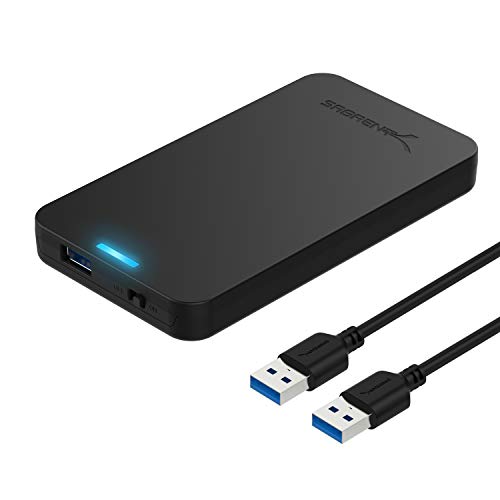
- Tool-free 2.5-inch SATA installation
- Up to 5Gbps USB 3.0 transfers
- UASP and plug-and-play support
Best For: Affordable SATA SSD reuse and everyday media transfers
Balanced NVMe Pick

- Up to 3836MB/s real-world performance
- USB4, Thunderbolt, and USB-C compatibility
- Supports 2230, 2242, and 2280 NVMe drives
Best For: Portable NVMe editing storage across modern devices
Flexible SATA Option

- USB-C and USB-A connection options
- Tool-free installation with UASP
- Supports 2.5-inch SATA drives up to 6TB
Best For: Versatile SATA storage across mixed computer ports
Best Active-Cooling Pick
ACASIS 40Gbps M.2 NVMe Enclosure

- 40Gbps USB4 and Thunderbolt compatibility
- Built-in switch-activated cooling fan
- Supports 2230–2280 M.2 NVMe drives
Best For: Sustained video editing transfers on compatible Macs and PCs
Best Data-Protection Features
DOCKCASE Explorer M.2 Enclosure

- Display shows SSD health and capacity information
- Around 10 seconds of power-loss protection
- 10Gbps USB-C with thermal management
Best For: Editors prioritizing diagnostics and write-data protection
Best 40Gbps Single-Drive Pick
Yottamaster M.2 NVMe Enclosure

- 40Gbps Thunderbolt 4/USB4 connectivity
- Active cooling for sustained workloads
- Tool-free support for M.2 2230–2280 SSDs
Best For: Single-drive 4K editing setups
Best Multi-Drive Capacity Pick

- Four M.2 NVMe bays for up to 32TB
- 40Gbps connectivity for large transfers
- Active cooling with hot-swap support
Best For: Large media libraries and multi-drive workflows
Best Next-Generation Speed Pick
ACASIS 80Gbps M.2 NVMe Enclosure

- 80Gbps interface with up to 6,000MB/s claimed speeds
- 60W PD charging for compatible laptops
- Smart fan and tool-free installation
Best For: Thunderbolt 5 and USB4 V2 editing systems
Top-Speed Pick – OWC Express 1M2 80G USB4
For demanding video editing workflows, the OWC Express 1M2 is one of the fastest SSD enclosures for video editing in this roundup. Its USB4 connection reaches over 6000MB/s in real-world use, while the heat-dissipating aluminum design is built to help maintain consistent performance during sustained transfers.
Best For: Editors who need maximum portable NVMe performance and broad compatibility with USB4, Thunderbolt, and USB-C devices.
Pros:
- Over 6000MB/s peak real-world speed
- Supports PCIe Gen 3.0, 4.0, and selected 5.0 NVMe M.2 SSDs
- Works with Macs, PCs, iPad Pros, Chromebooks, and Surface devices
- Patented cooling design and included USB4 cable
Cons:
- Performance depends on the host device, cable, and installed SSD
- PCIe Gen 5 SSD selection requires attention to power consumption
This is the strongest choice for high-bandwidth editing and large media transfers, especially when paired with a compatible USB4 host and a fast NVMe drive.
Budget SATA Choice – SABRENT 2.5in USB 3.0 Enclosure
The SABRENT EC-UASP is a straightforward option among SSD enclosures for video editing when you already have a 2.5-inch SATA SSD. Its tool-free installation and USB 3.0 interface make it easy to turn an internal drive into a portable editing or media-transfer drive.
Best For: Budget-conscious editors using 2.5-inch SATA SSDs who value simple installation and broad Windows and Mac support.
Pros:
- Tool-free, plug-and-play installation
- USB 3.0 transfer rates up to 5Gbps with UASP SATA III support
- Backward compatible with USB 2.0 and USB 1.1
- Supports hot-swapping without requiring drivers
Cons:
- Limited to 2.5-inch SATA drives
- Slower than USB4 NVMe enclosures for demanding editing workloads
This enclosure is a practical way to reuse a SATA SSD for editing projects, backups, or file transport, but it is not the best fit for users seeking the highest preview and scratch-disk speeds.
Balanced NVMe Pick – OWC Express 1M2 40Gb/s
The OWC Express 1M2 40Gb/s balances speed, portability, and compatibility for video editing. It delivers up to 3836MB/s real-world performance with a compatible NVMe M.2 SSD, and its USB4, Thunderbolt, and USB-C support makes it suitable for a wide range of editing computers and tablets.
Best For: Editors who want fast NVMe performance in a compact enclosure without requiring the highest-speed 80Gb/s setup.
Pros:
- Up to 3836MB/s real-world performance
- Compatible with USB4, Thunderbolt, and USB-C devices
- Supports M.2 2280, 2242, and 2230 NVMe SSDs
- Includes a 40Gb/s USB-C cable and screwdriver
Cons:
- Actual speed depends on the host device and installed SSD
- Requires an NVMe M.2 drive for use
For many editors, this is the most balanced OWC option: substantially faster than typical SATA enclosures while remaining compact, bus-powered, and broadly compatible.
Flexible SATA Option – BENFEI 2.5in USB-C/Type-A
The BENFEI enclosure is a flexible choice for editors who use 2.5-inch SATA SSDs and want both USB-C and USB-A connection options. Its tool-free design, UASP support, and plug-and-play operation make it convenient for moving footage between computers and using an older SSD as external storage.
Best For: Editors who need an inexpensive 2.5-inch SATA enclosure with versatile USB-C and USB-A connectivity.
Pros:
- Supports USB Type-C and Type-A connections
- Tool-free installation with plug-and-play operation
- Up to 5Gbps transfer performance with UASP support
- Compatible with Windows, Linux, and MacOS 8.0 and above
Cons:
- Limited to 2.5-inch SATA drives
- Not as fast as the NVMe USB4 enclosures in this roundup
- Designed for drives up to 6TB and 7/9.5mm thickness
This is a sensible everyday enclosure for SATA-based editing storage, particularly when your workflow includes computers with different USB port types.
Best Active-Cooling Pick – ACASIS 40Gbps M.2 NVMe Enclosure
For video editors choosing among SSD enclosures for video editing, the ACASIS TBU405 Pro stands out for combining USB4-class bandwidth with active cooling. Its built-in fan and aluminum construction are designed to help maintain performance during demanding transfers and extended workloads.
Best For: Professionals using compatible M.2 NVMe drives with Thunderbolt 3, Thunderbolt 4, or USB4-equipped Macs and PCs.
Pros:
- 40Gbps connectivity with tested read/write speeds up to 2805/2734 MB/s under the stated test conditions.
- Built-in cooling fan and heat-dissipation openings help reduce thermal throttling during heavy workloads.
- Supports 2230, 2242, 2260, and 2280 M.2 NVMe drives, plus M1/M2/M3 Pro and Max Macs, iPad Pro, Windows, and Linux.
- Compact aluminum design with compatibility across Thunderbolt and USB standards.
Cons:
- The fan must be activated with its switch, so cooling is not automatic.
- Maximum performance depends on the host port, SSD, and test conditions.
- Designed for NVMe drives rather than SATA M.2 SSDs.
The ACASIS is a strong choice when sustained performance and heat management matter more than absolute simplicity. Its active cooling and broad host compatibility make it particularly suitable for mobile editing workflows using fast NVMe media.
Best Tool-Free Option – SABRENT USB4 NVMe SSD Enclosure
The SABRENT EC-U4TN is a practical pick among SSD enclosures for video editing when quick drive installation and high throughput are priorities. It supports USB4 speeds up to 3,900 MB/s and includes active cooling for large file transfers.
Best For: Creators and editors who regularly move large files between modern USB4, Thunderbolt, or USB-C computers.
Pros:
- Up to 3,900 MB/s over USB4 and up to 2,700 MB/s over Thunderbolt 3 or 4, according to the supplied specifications.
- Tool-free installation supports PCIe NVMe drives in 2230, 2242, 2260, and 2280 sizes.
- Integrated fan and aluminum/ABS construction are designed to support stable performance during large transfers.
- Plug-and-play operation requires no drivers or external power, and it works with Windows and macOS.
Cons:
- It does not support SATA M.2 SSDs; only PCIe NVMe drives are compatible.
- Real-world speeds depend on the host connection and installed SSD.
- USB4-class performance requires a compatible USB4 host.
The EC-U4TN balances speed and convenience well. Its tool-free design is useful for editors who swap NVMe drives, while the active fan adds reassurance during lengthy media transfers.
Best Data-Protection Features – DOCKCASE Explorer M.2 Enclosure
For editors who value drive monitoring and protection alongside speed, the DOCKCASE Explorer is a distinctive option among SSD enclosures for video editing. Its display reports SSD health information, while power-loss protection is designed to provide around 10 seconds of writing time after a power failure.
Best For: Video editors who want visible SSD diagnostics and added protection for write operations over a 10Gbps USB-C connection.
Pros:
- HD display can show SSD health, estimated life, power-on times, and remaining capacity.
- Approximately 10 seconds of power-loss protection may help prevent write-data loss after an outage.
- USB 3.2 Gen 2 Type-C supports theoretical speeds up to 10Gbps, with stated performance above 900 MB/s using high-performance NVMe media.
- Supports 2230, 2242, 2260, and 2280 drives, with graphite thermal padding and temperature-control features.
Cons:
- Its 10Gbps interface is slower than the USB4 enclosures in this roundup.
- Power-loss protection duration varies with the SSD’s workload and power consumption.
- The supplied warranty is one year, shorter than the two-year warranties listed for the other options.
The DOCKCASE is less focused on maximum transfer speed and more focused on visibility and data safety. It makes sense for editors who appreciate at-a-glance drive information and work with files where unexpected power loss is a concern.
Best 40Gbps Single-Drive Pick – Yottamaster M.2 NVMe Enclosure
For editors seeking practical ssd enclosures for video editing, the Yottamaster combines 40Gbps connectivity with active cooling and tool-free installation. With a compatible Thunderbolt 3/4 or USB4 host and a suitable 40Gbps cable, it is designed for sustained transfers and 4K workflows.
Best For: Video editors who need a compact, single-drive enclosure for a 2230, 2242, 2260, or 2280 M.2 NVMe SSD.
Pros:
- 40Gbps performance with typical sustained speeds of 2,800–3,200MB/s under suitable conditions.
- Active cooling fan, aluminum construction, and overcurrent and overheating protection.
- Tool-free installation with a clear cover that shows the activity LED and fan status.
- Supports SSDs up to 8TB and includes a 2-in-1 cable.
Cons:
- Actual speeds depend on the SSD, host system, cable, files, and operating conditions.
- Requires a compatible Thunderbolt or USB4 host to reach its top performance.
The Yottamaster is a focused choice when you want fast external scratch or project storage without the size and complexity of a multi-drive enclosure. Its cooling and tool-free design make it particularly convenient for frequent SSD swaps and demanding 4K work.
Best Multi-Drive Capacity Pick – TERRAMASTER D4 NVMe Enclosure
The TERRAMASTER D4 stands out among ssd enclosures for video editing when one drive is not enough. It houses four M.2 NVMe 2280 SSDs, supports up to 32TB of combined capacity, and provides 40Gbps connectivity for large media libraries and project transfers.
Best For: Editors, studios, and creators who need multiple NVMe drives for high-capacity storage, backups, or separate project volumes.
Pros:
- Supports four M.2 NVMe 2280 SSDs, with up to 8TB per drive.
- Up to 3,224MB/s with four 990 PRO SSDs, or 1,608MB/s with a single SSD, according to the supplied specifications.
- Temperature-controlled fans and four internal sensors help manage heat, with standby noise rated at 19dB(A).
- Works with Windows, Mac, Linux, Android, and iOS, and supports tool-free access and hot-swapping.
Cons:
- No built-in RAID; software RAID requires third-party tools.
- It is larger and heavier than a single-drive enclosure and requires its included power adapter.
- Performance varies with the number and models of installed SSDs.
The D4 is a flexible desktop storage hub rather than a minimal portable enclosure. Its four bays, cooling system, backup features, and broad compatibility make it a strong fit for editors managing large footage collections, provided the lack of built-in RAID is acceptable.
Best Next-Generation Speed Pick – ACASIS 80Gbps M.2 NVMe Enclosure
For compatible next-generation systems, the ACASIS is one of the more advanced ssd enclosures for video editing. Its 80Gbps interface, support for PCIe 5.0 SSDs, 60W power delivery, and intelligent fan target fast mobile editing and demanding content-creation workloads.
Best For: Editors using Thunderbolt 5 or USB4 V2 systems who want high-speed storage and laptop charging through one connection.
Pros:
- Supports up to 80Gbps connectivity and read/write speeds of up to 6,000MB/s with suitable hardware.
- Provides up to 60W PD charging while accessing external storage.
- Intelligent cooling fan adjusts operation according to SSD temperature.
- Tool-free design, included 80Gbps cable, and backward compatibility with 40Gbps, USB4 V1, and USB 3.x devices.
Cons:
- Exceeding 3,000MB/s requires a compatible PCIe 4.0 x4 NVMe 1.4 or newer SSD and suitable host hardware.
- Not compatible with Thunderbolt 3 devices.
- The enclosure can become warm during sustained transfers and needs a well-ventilated position.
The ACASIS makes the most sense for a forward-looking editing setup with Thunderbolt 5 or USB4 V2. Its performance ceiling and pass-through charging are compelling, but buyers should verify host compatibility carefully—especially because Thunderbolt 3 is excluded.
How We Picked the Best SSD Enclosures for Video Editing
We focused on enclosures that suit practical editing workflows rather than judging them only by advertised burst speeds. The selection covers NVMe and 2.5-inch SATA formats, USB 3.2, USB4, and 40Gbps or 80Gbps connections, along with different price and capacity strategies.
We also considered tool-free installation, portability, thermal management, compatibility with modern computers, and features that can reduce workflow interruptions. Because an enclosure’s performance depends on the installed SSD, host port, cable, and file workload, listed speeds should be treated as maximum interface figures rather than guaranteed sustained results.
Quick Comparison
- Maximum speed: 80Gbps USB4 and USB4 v2 models offer the most headroom, provided the computer and cable support those standards.
- Balanced performance: 40Gbps NVMe enclosures are a strong fit for high-bitrate video, transfers, and active project files.
- Affordable upgrades: 2.5-inch SATA enclosures work well with older SSDs and typically cost less, but their interface limits throughput.
- Expanded capacity: A four-bay enclosure can consolidate multiple NVMe drives, though it is less portable and may require more configuration.
Key Buying Factors for SSD Enclosures for Video Editing
Interface and Real-World Speed
Check the ports on your computer before choosing a fast enclosure. USB4 and Thunderbolt-compatible models can deliver much higher throughput than USB 3.2 Gen 2, but only when the host port, cable, and SSD support the required standard. A slower connection will bottleneck even the fastest NVMe drive.
NVMe Versus SATA Compatibility
NVMe enclosures are generally the better choice for demanding editing, large media transfers, and scratch-disk use. SATA enclosures are suitable for repurposing 2.5-inch SSDs, storing completed projects, or creating economical backup drives. NVMe and SATA M.2 drives are not interchangeable, so confirm the enclosure’s supported protocol and physical size.
Cooling, Power, and Reliability
Sustained video transfers can generate heat and trigger thermal throttling. Look for a substantial heat spreader, thermal pad, or cooling fan when working with fast NVMe drives. Tool-free access is convenient, while power-loss protection features may help reduce write-data risk in supported workflows. Use a quality cable and safely eject the drive when possible.
Who Should Buy Which SSD Enclosures for Video Editing?
Choose a compact 40Gbps NVMe enclosure if you want a portable working drive for a laptop, desktop, or mobile editing setup. Choose an 80Gbps model if your workstation supports the latest USB4 standard and you regularly move very large files.
Choose a 2.5-inch SATA enclosure for an inexpensive way to reuse an existing SATA SSD or build a straightforward backup drive. Choose a fan-cooled enclosure for long transfers and sustained workloads in which heat may limit performance.
Choose a multi-bay NVMe enclosure if you need several drives in one desktop-oriented unit, greater project capacity, or a more organized storage setup. Whatever you buy, verify drive support, host compatibility, cable requirements, and your preferred backup strategy before putting important footage on it.