
NAS enclosures with dual 2.5GbE can deliver a noticeable step up from standard gigabit networking, especially when several users access files, stream media, or run backups at once.
Our selected models range from compact two-bay systems to expandable four-, five-, and six-bay enclosures, with options for beginners, creators, remote workers, and demanding home labs.
Best 10 Nas Enclosures with 2 5gbe Picks for 2026
Best Overall
ASUSTOR Lockerstor 2 Gen2+ 2-Bay NAS
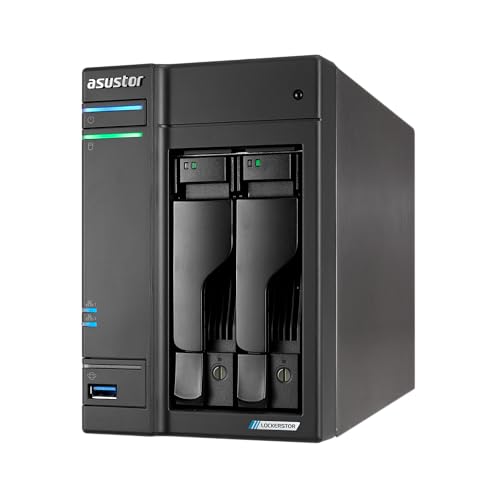
- Dual 5GbE ports for faster network transfers
- Four M.2 NVMe slots for cache or flash storage
- Intel quad-core CPU with HDMI and 4K media support
Best For: Creators and small businesses needing fast two-bay storage
Best High-Capacity Option

- Dual 10GbE networking for demanding transfers
- Four bays plus U.2 and M.2 expansion
- Ryzen CPU, expandable RAM, Docker, and surveillance support
Best For: Creators and teams needing expandable high-speed storage
Best NAS-Mini PC Hybrid

- 5GbE plus 2.5GbE dual-network connectivity
- Two HDD bays and three M.2 SSD slots
- 16GB LPDDR5 and dual 4K display support
Best For: Home users wanting a compact NAS and mini PC in one
Best Budget Alternative

- Budget-focused two-bay storage platform
- 2.5GbE for faster-than-Gigabit file transfers
- 4GB RAM and quad-core ARM processor
Best For: Families needing simple personal storage and media streaming
Best Beginner NAS

- Four-bay storage with up to 128TB capacity
- Automatic photo backup with AI albums
- 8GB RAM and 2.5GbE networking
Best For: Families and first-time NAS buyers
Best High-Speed NAS

- 10GbE and 5GbE ports with link aggregation
- Up to 174TB across five SATA bays
- Expandable DDR5 RAM and multiple M.2 slots
Best For: Power users and multi-user high-speed workflows
Best Six-Bay NAS

- Six hot-swappable SATA drive bays
- Dual 2.5GbE ports for faster transfers
- Dual M.2 slots and USB 3.2 Gen 2
Best For: Home offices and small teams needing more bays
Best Beginner-Friendly Pick

- Four bays with RAID 0, 1, or 5 support
- Dual 2.5GbE, Intel N100, and 8GB RAM
- 4K HDMI, AI albums, and guided setup
Best For: Families and first-time NAS buyers wanting expandable home storage
Best Media-Centric Compact Option

- Dual 2.5GbE ports with claimed 5Gbps combined transfers
- Two HDD bays plus two M.2 NVMe slots
- 4K60 HDMI and automatic movie scraping
Best For: Compact home media libraries and direct TV playback
Best Established Ecosystem Choice

- Dual 2.5GbE with 8GB DDR4 RAM
- M.2 slots for cache or SSD storage pools
- USB 3.2 Gen 2 and PCIe expansion support
Best For: Home offices and advanced users planning future upgrades
Best Overall – ASUSTOR Lockerstor 2 Gen2+ 2-Bay NAS
For shoppers comparing NAS enclosures with 2 5GbE, the ASUSTOR Lockerstor 2 Gen2+ stands out with dual 5GbE ports, four M.2 NVMe slots, and an Intel quad-core processor. It is a strong fit for faster file transfers, media serving, and creative workloads, though storage drives must be added separately.
Best For: Creators, small businesses, and users who want a compact two-bay NAS with high-speed networking and extensive NVMe acceleration.
Pros:
- Dual 5GbE ports support faster transfers than standard Gigabit networking.
- Four M.2 NVMe slots can provide caching or an all-flash storage pool.
- Intel Celeron N5105, 4GB DDR4, HDMI, and Plex-ready 4K transcoding support.
Cons:
- Only two SATA drive bays are included.
- Drives are not included, and faster networking requires compatible equipment.
This is a well-rounded choice when dual 5GbE connectivity and NVMe flexibility matter more than maximum bay count. Its expandable memory and media features also leave room for future growth.
Best High-Capacity Option – UGREEN DXP4800 GT 4-Bay NAS
Although it exceeds the two-port 5GbE target with dual 10GbE networking, the UGREEN DXP4800 GT is worth considering for buyers who want a more expandable NAS enclosure. Its four bays, Ryzen processor, large memory ceiling, and creator-focused input options are designed for demanding storage and media workflows.
Best For: Creators, office teams, and advanced home users who need high capacity, fast networking, and support for containers or virtual machines.
Pros:
- Dual 10GbE ports can provide up to 20Gbps aggregate bandwidth with compatible equipment.
- Four SATA bays, U.2 support in up to two bays, and two M.2 slots offer substantial expansion.
- Includes SD backup, multiple 10Gbps USB ports, 4K HDMI, Docker, and surveillance features.
Cons:
- It is a four-bay system rather than a compact two-bay enclosure.
- Drives are not included.
- Its advanced feature set may be more than basic file-storage users need.
The DXP4800 GT is the strongest capacity and performance choice in this group, but it is best viewed as an upgrade path beyond a typical dual-5GbE NAS. Its hardware and software features suit users building a broader private-cloud or media platform.
Best NAS-Mini PC Hybrid – Beelink ME Pro 5GbE NAS PC
The Beelink ME Pro takes a different approach to NAS enclosures with 2 5GbE by combining a compact mini PC with two SATA bays and three M.2 PCIe 3.0 slots. With a 5GbE port, 2.5GbE port, 16GB LPDDR5 memory, and a preinstalled 1TB SSD, it is aimed at users who want storage, private-cloud functions, and general-purpose computing in one small chassis.
Best For: Home users who want a compact private cloud, media hub, soft router, or flexible mini-server rather than a traditional NAS appliance.
Pros:
- Combines two HDD bays with three M.2 SSD slots and supports up to 72TB expansion.
- 5GbE and 2.5GbE ports support high-speed transfers and network aggregation.
- Intel N150, 16GB LPDDR5, dual 4K display output, and a compact metal design.
Cons:
- It has one 5GbE port rather than two.
- Its operating-system experience is less specifically defined than a dedicated NAS platform.
- Memory is listed as fixed at 16GB.
This hybrid is compelling when desktop-computer flexibility and small size are priorities. Choose it over a conventional NAS when you also need display outputs, soft-routing capability, or a general mini-PC platform.
Best Budget Alternative – QNAP TS-216G 2-Bay NAS
QNAP TS-216G-US 2-Bay 2.5GbE Desktop NAS | ARM Quad-Core CPU, Built-In NPU, 4GB RAM, Diskless
Check Price On AmazonThe QNAP TS-216G is a straightforward two-bay NAS for shoppers who want affordable network storage but do not require dual 5GbE. Its 2.5GbE connectivity, 4GB of RAM, and quad-core ARM processor are suited to file sharing, family media organization, and streaming.
Best For: Home users and families seeking a budget-friendly two-bay NAS for personal files and multimedia.
Pros:
- 2.5GbE accelerates file sharing beyond standard Gigabit networking.
- Quad-core ARM processor and 4GB DDR4 support everyday NAS tasks.
- Designed for centralized storage and personal media organization.
Cons:
- It does not provide 5GbE connectivity.
- The supplied details do not list NVMe slots or HDMI output.
- It is diskless, so storage drives must be purchased separately.
The TS-216G is a practical value pick if your network equipment and workload do not justify 5GbE. It delivers the basic two-bay NAS experience at a lower-complexity feature level than the faster alternatives.
Best Beginner NAS – UGREEN NAS DH4300 Plus
If you want nas enclosures with 2 5gbe for straightforward home storage, the UGREEN NAS DH4300 Plus is an approachable four-bay option. It offers 8GB LPDDR4X RAM, a 2.5GbE port, Docker support, automatic backups, remote access, and 4K HDMI output. Drives are not included.
Best For: Beginners, families, remote workers, and users moving from cloud storage or external drives to a private home cloud.
Pros:
- Four bays and support for up to 128TB of capacity.
- Automatic phone photo and video backup with AI-powered album organization.
- Beginner-friendly setup across Windows, macOS, Android, iOS, browsers, and smart TVs.
- Local storage, encryption, and automatic backups provide greater control over personal data.
Cons:
- It has one 2.5GbE port rather than dual 5GbE networking.
- It supports Docker but not virtual machines.
- Storage disks must be purchased separately.
The DH4300 Plus is best viewed as a simple, family-focused private cloud rather than a high-end virtualization platform. Its photo tools, accessible software, and four-bay design make it a practical starting point for centralized storage.
Best High-Speed NAS – MINISFORUM N5 Air 5-Bay
Among nas enclosures with 2 5gbe, the MINISFORUM N5 Air stands out for users who need more network bandwidth and expansion headroom. Its five SATA bays, 10GbE and 5GbE ports, Ryzen 7 255 processor, dual DDR5 slots, three M.2 slots, and PCIe x16 slot support demanding storage and media workflows.
Best For: Power users, creative teams, multi-user households, and anyone managing large files or high-speed collaborative workloads.
Pros:
- Dual 10GbE and 5GbE networking supports link aggregation up to 15Gbps.
- Five SATA bays support up to 174TB, with additional M.2 NVMe flexibility.
- Ryzen 7 255 CPU, expandable DDR5 memory up to 96GB, and dual USB4 ports.
- Supports RAID options, ZFS snapshots, Docker apps, remote access, and up to three 8K displays.
Cons:
- Its advanced expansion and networking features may be more than basic users need.
- The OCuLink interface is not hot-swappable.
- Drive capacity depends on separately installed storage.
The N5 Air is the strongest performance-oriented choice in this group. Its combination of 10GbE and 5GbE connectivity, expandable memory, and multiple storage interfaces gives it considerable room for demanding workloads and future upgrades.
Best Six-Bay NAS – QNAP TS-664-8G-US
The QNAP TS-664-8G-US is a practical six-bay desktop NAS for buyers comparing nas enclosures with 2 5gbe. It includes dual 2.5GbE ports, 8GB DDR4 memory, dual M.2 NVMe slots, hot-swappable drive support, and USB 3.2 Gen 2 connectivity for family or business file storage.
Best For: Small teams, home offices, and families that want six bays, dual 2.5GbE networking, and flexible storage expansion.
Pros:
- Six bays provide more drive capacity and configuration flexibility than four- or five-bay models.
- Dual 2.5GbE ports can accelerate file sharing and large transfers.
- Two M.2 PCIe Gen3x2 slots support cache acceleration or SSD storage pools.
- Hot-swappable SATA drive design and multiple USB 3.2 Gen 2 ports simplify maintenance and transfers.
Cons:
- The network ports are 2.5GbE, not 5GbE or 10GbE.
- The included 8GB DDR4 RAM is onboard and non-expandable.
- Hard drives are not specified as included in the supplied details.
Choose the TS-664 when bay count and practical expansion matter more than maximum network speed. Its six-drive layout, dual 2.5GbE ports, NVMe support, and hot-swap design create a balanced platform for centralized home or small-business storage.
Best Beginner-Friendly Pick – Yxk Zero1 Pro 4-Bay NAS
For shoppers comparing NAS enclosures with 2 5GbE, the Yxk Zero1 Pro offers two 2.5GbE ports in a flexible four-bay design. Its Intel N100 processor, guided setup, RAID support, and 4K HDMI output make it a practical starting point for family backups, home media, and small-office file sharing.
Best For: Families and beginners who want expandable storage, private cloud access, and straightforward home-server features.
Pros:
- Four SATA bays support up to four 32TB drives and RAID 0, 1, or 5.
- Two 2.5GbE ports can support link aggregation with compatible networking equipment.
- Intel N100, 8GB RAM, dual M.2 slots, and Docker support suit varied home-server projects.
- Guided mobile setup, AI photo organization, and 4K HDMI add family-friendly convenience.
Cons:
- It is diskless, so HDDs or SSDs must be purchased separately.
- Link aggregation requires compatible network equipment and does not automatically provide 5Gbps to one device.
- Third-party operating-system compatibility and features may vary.
The Zero1 Pro stands out when capacity and expandability matter more than a compact footprint. It is a strong all-around option for a first NAS, provided you budget for drives and compatible networking hardware.
Best Media-Centric Compact Option – ORICO MetaHome CS200Pro
The ORICO MetaHome CS200Pro is a compact choice among NAS enclosures with 2 5GbE, combining two 2.5GbE ports with two HDD bays and two M.2 NVMe slots. Its CyberData OS, 4K HDMI output, automatic movie scraping, and AI photo albums focus the system on accessible home media and personal storage.
Best For: Home users building a small media library with direct TV playback, remote access, and hybrid HDD/SSD storage.
Pros:
- Two 2.5GbE ports can be combined for up to 5Gbps transfers with compatible equipment.
- Two HDD slots and two M.2 NVMe slots provide flexible mass storage and SSD use.
- 4K at 60Hz HDMI output and automatic movie scraping help create a catalog-style media library.
- Fan controls, temperature monitoring, snapshots, and AI photo categorization add useful management tools.
Cons:
- The enclosure is diskless and supports up to 64TB according to the supplied specifications.
- Actual transfer performance depends on the network, storage devices, and configuration.
- The web interface was still described as under development in the supplied notes.
This ORICO model prioritizes a polished home-media experience in a relatively compact two-bay enclosure. Consider it if HDMI playback and automated library organization are more important than four-drive expansion.
Best Established Ecosystem Choice – QNAP TS-264-8G-US 2-Bay NAS
For buyers seeking NAS enclosures with 2 5GbE from an established NAS brand, the QNAP TS-264-8G-US pairs dual 2.5GbE connectivity with an Intel Celeron quad-core processor and 8GB of DDR4 RAM. Its two drive bays, M.2 PCIe slots, USB 3.2 Gen 2 ports, and PCIe expansion slot support future upgrades.
Best For: Home offices and advanced users who want a capable two-bay NAS with expansion options for networking, storage, and accessories.
Pros:
- Dual 2.5GbE ports support faster file sharing across compatible networks.
- Two M.2 PCIe Gen3x1 slots can be used for cache acceleration or SSD storage pools.
- Multiple USB 3.2 Gen 2 ports support fast transfers and expansion enclosures.
- A PCIe Gen3 x2 slot allows compatible network, QM2, and other expansion cards.
Cons:
- The two-bay design provides less drive capacity and RAID flexibility than a four-bay enclosure.
- It is diskless, so compatible storage must be added separately.
- Real-world 2.5GbE performance depends on the network and connected devices.
The TS-264-8G-US is a sensible fit for users who value QNAP’s expandable hardware platform and need more than basic file storage. Its dual M.2 slots, USB connectivity, and PCIe slot give it room to evolve as your setup grows.
How We Picked the Best Nas Enclosures with 2 5gbe
We focused on models that offer two multi-gigabit Ethernet connections or a closely related high-speed networking configuration, then compared their drive capacity, processor performance, memory, expansion options, software ecosystem, and intended audience. We also considered whether each enclosure is diskless or includes storage, since adding drives can substantially change the total cost.
Dual 2.5GbE is most useful when your network switch, router, and client devices support multi-gigabit speeds. Link aggregation may improve access for multiple users, but it does not always double the speed of a single file transfer.
Quick Comparison
| Best For | Recommended Type | Why It Fits |
|---|---|---|
| Basic home backups | Two-bay NAS | Lower cost and simple mirrored storage |
| Media libraries | Two- or four-bay NAS | Good balance of capacity, streaming, and expansion |
| Creators and offices | Four- to six-bay NAS | More drive capacity and stronger multitasking |
| Home labs | Multi-M.2 or high-core-count model | Better support for SSD pools, containers, and virtual machines |
Key Buying Factors for NAS Enclosures with 2.5GbE
Drive Bays and Storage Planning
Two bays are suitable for a mirrored RAID 1 setup, while four or more bays provide greater usable capacity, flexible RAID levels, and easier expansion. Check the maximum supported drive size and whether the enclosure accepts 3.5-inch hard drives, 2.5-inch drives, M.2 SSDs, or a combination.
Processor and Memory
An entry-level Intel or AMD processor is sufficient for backups, file sharing, and light media serving. Choose a stronger CPU and more memory for multiple users, hardware transcoding, Docker containers, surveillance, or virtual machines. Upgradeable RAM can extend the system’s useful life.
Networking and Expansion
Confirm that both Ethernet ports are genuinely 2.5GbE and check whether the operating system supports link aggregation, failover, or separate network services. M.2 slots, PCIe expansion, HDMI output, and USB ports may also matter if you plan to add SSD caching, faster networking, or direct-display playback.
Software, Security, and Remote Access
Review the platform’s backup tools, mobile apps, snapshots, user permissions, cloud synchronization, and remote-access controls. Enable multifactor authentication, keep firmware updated, and avoid exposing administration ports directly to the internet.
Who Should Buy Which Nas Enclosures with 2 5gbe?
Choose a two-bay model if you want an affordable personal cloud, centralized backups, or a compact Plex and media server. A four-bay enclosure is the better all-around choice for growing libraries, small offices, and users who want more RAID flexibility. Five- and six-bay systems suit creators, power users, and teams that need higher capacity, more simultaneous workloads, or room for future expansion.
Before buying, verify drive compatibility, operating-system features, included accessories, and the cost of hard drives or SSDs. The best NAS is not simply the fastest model; it is the enclosure that matches your network, storage growth, workload, and backup strategy.