
KODAK Luma 150 Mini Projector review: this is a compact answer for people who want a small, battery-powered projector without dragging around a full home theater setup.
It is best understood as a portable convenience device first and a cinematic display second.
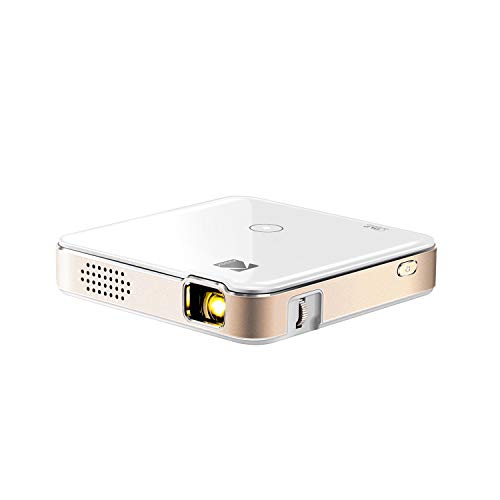
Luma 150 Mini Projector Review Summary
The KODAK Luma 150 Mini Projector makes sense for buyers who care about portability, simple hookups, and flexible room-to-room use more than maximum brightness.
If you want a lightweight projector for casual movies, quick presentations, family photos, or travel-friendly screen sharing, this model has a clear appeal.
What stands out most is the mix of multiple input options, wireless mirroring support, and a built-in rechargeable battery.
That combination makes the product easy to move and easy to use in places where a fixed entertainment setup is impractical.
The tradeoff is equally clear: the listed brightness and native resolution place it in the compact projector category, not the high-output home theater class.
Review Scorecard
| Category | Score | Why it earns that score |
|---|---|---|
| Portability | 9/10 | Small form factor and rechargeable battery make it easy to move and use away from outlets. |
| Connection flexibility | 8/10 | HDMI, Micro USB, AirPlay, and Miracast cover several common viewing setups. |
| Everyday convenience | 8/10 | Built-in speaker and onboard controls reduce the need for extra gear. |
| Media compatibility | 7/10 | Works well with phones, laptops, storage devices, and external streaming devices. |
| Picture capability | 6/10 | The listed 60 ANSI lumen brightness and 854 x 480 resolution limit its ambition. |
| Travel and gifting appeal | 8/10 | The compact design and battery-powered operation make it easy to recommend as a gift or carry-along device. |
| Best-value fit | 7/10 | Strong feature set for casual use, but only if expectations stay aligned with a small projector’s limits. |
Key Features and Specifications of Luma 150 Mini Projector
The KODAK Luma 150 Mini Projector is built around portability and simple source switching rather than raw display power.
The listing describes it as a pocket projector that can produce video and images up to 150 inches, though that figure should be read as a maximum projection claim, not a promise of theater-grade performance in every room.
The core hardware and usage notes from the listing are straightforward:
| Feature | Listed detail |
|---|---|
| Brand | KODAK |
| Model | Luma 150 Mini Projector |
| Input resolution support | 1080p input |
| Native resolution | 854 x 480 |
| Brightness | 60 ANSI lumens |
| Aspect ratio | 16:9 |
| Contrast ratio | 1000:1 |
| Power | Rechargeable battery, up to 2.5 hours |
| Audio | Built-in speaker |
| Physical controls | Illuminated onboard controls |
| Wired connections | HDMI and Micro USB |
| Wireless sharing | AirPlay and Miracast |
The listing also notes compatibility with cameras, storage drives, PCs, laptops, and similar devices through the included hookup methods.
That makes the projector more versatile than a single-purpose travel screen, especially if you need a simple way to show content from different sources in different places.
There is one important limitation in the product details: copyrighted streaming content such as Netflix or Hulu cannot simply be mirrored or screencast from a phone in the same way as ordinary local media.
The listing says that kind of content can be viewed by plugging in an external streaming device, such as a Fire TV Stick or Roku.
That matters because it affects how easy the projector will be for movie nights if your setup depends heavily on streaming apps.
Pros and Cons of Luma 150 Mini Projector
Pros
- Very portable design with battery power for use away from a wall outlet.
- Flexible connection choices through HDMI, Micro USB, AirPlay, and Miracast.
- Built-in speaker reduces the amount of extra gear needed for casual viewing.
- Works with several device types, including phones, laptops, cameras, and external drives.
- Good giftability for people who want a small, simple projector instead of a bulky system.
Cons
- 60 ANSI lumens is modest, so it is not the right choice for bright rooms or large-screen ambitions.
- Native 854 x 480 resolution means detail will not match sharper portable or home theater projectors.
- Battery life is limited to up to 2.5 hours, which may not cover longer viewing sessions.
- Streaming app mirroring has restrictions, especially for copyrighted services.
- Best for casual use, not for buyers expecting high-end image quality.
Who Should Buy Luma 150 Mini Projector?
The KODAK Luma 150 Mini Projector is a sensible buy for people who want a projector they can move easily and use without a complicated setup.
It fits casual users, travelers, students, and families who need something portable for quick entertainment, photos, or basic presentations.
It also makes sense if you want a battery-powered projector for occasional use rather than a permanent media centerpiece.
The onboard speaker and compact design keep the experience simple, which is part of the appeal.
You should probably skip it if your priority is a bright image, crisp fine detail, or dependable performance in a well-lit room.
Buyers who want a living-room movie machine or a projector for more demanding home theater use should look higher up the brightness and resolution ladder.
Portable Projection Tradeoffs with Luma 150 Mini Projector
Battery Use and Mobility
The battery is the headline convenience feature here.
Up to 2.5 hours of power gives the projector a clear edge for short sessions, quick demos, or casual use where charging access is limited.
That is enough for many everyday scenarios, but it naturally shapes the product toward smaller viewing windows rather than long marathons.
Input Flexibility
HDMI and Micro USB keep the unit useful with wired sources, while AirPlay and Miracast add a wireless path for mobile mirroring.
That spread of options is one of the strongest reasons to consider the Luma 150, because it reduces the chance that a single device or cable problem will leave you stuck.
Image Expectations
The listed 60 ANSI lumens and 854 x 480 resolution define the projector’s ceiling.
Those specs do not make it a bad product, but they do set a realistic frame: this is for convenience and portability, not for buyers chasing a bright, razor-sharp image across a big wall in a room with plenty of ambient light.
Streaming and Source Choice
The listing’s note about copyrighted content is important because it changes how the projector should be used.
If your media library lives inside phone apps, you may need an external streaming stick instead of relying on mirroring alone.
For local files, presentations, and non-copyrighted content, the projector’s source flexibility is more straightforward.
Alternatives to Luma 150 Mini Projector
If you want to compare this model against other portable projectors, these are credible Amazon search starting points:
- Anker Nebula portable projector
- ViewSonic portable projector
- Epson portable projector
- XGIMI portable projector
The main reason to look at those alternatives is to compare battery convenience, brightness, and image quality expectations.
Some will emphasize sharper output or stronger light output, while others focus on being easy to pack and set up.
The right comparison depends on whether you value portability, picture quality, or a more balanced mix.
Is Luma 150 Mini Projector Worth It?
The KODAK Luma 150 Mini Projector is worth it if you want a compact, easy-to-carry projector for casual viewing and you understand its limits.
Its best traits are portability, battery power, and flexible input support, not maximum brightness or premium image sharpness.
If your use case is travel, quick setup, family sharing, or occasional presentations, this is a reasonable fit.
If you are hoping for a bright home theater projector, keep looking.
The listed specs make this a convenience-first model, and that is exactly how it should be judged.